It is unusual for a reporter to testify in a political setting. Whether before a state legislative committee or Congress, you don’t see many journalists sharing their knowledge or perspectives.
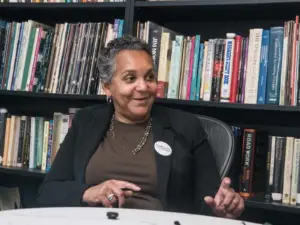
While understandable for many reasons, in another sense it’s also strange that those who often know the most about a topic would sit on the sidelines. And in Massachusetts, few non-attorneys know more about the strained parole system than longtime BINJ prison reporter Jean Trounstine.
Demonstrating her clear passion for these issues, Jean’s coverage of the Department of Correction, Parole Board, and Governor’s Council has been the most thorough in the state for nearly a decade. Her articles quote and consider all perspectives; but since those who make major decisions don’t always do the same, sometimes she speaks up beyond the margin.
Below you will find Jean’s recent testimony to the Governor’s Council in opposition of Parole Board candidate Vincent DeMore. Based on her reporting on the subject, it reflects the current state of the overworked agency. -Chris Faraone, Editorial Director
Good morning. I’m Jean Trounstine, a professor, author, and journalist who has extensively researched and written about parole for 15 years.
I come before you this morning in my capacity as both a professor and a writer, as my research and writing have led me to oppose the nomination of Atty. Vincent Demore.
I cite first of all the letter circulated by more than 400 individuals and organizations opposing the candidacy of Vincent DeMore, written by activists including Olivia Dubois of the social justice organization, Beyond Defense. I agree with the reasons that are mentioned there.
First off, the major part of Atty. DeMore’s career, as his resume shows—19 years—has been spent as a prosecutor or an ADA. That is not the experience needed by the Board to make decisions on those who are seeking second chances. Having attended more than 50 lifer parole hearings, it’s very clear that the Parole Board is in need of a member with knowledge and experience in parole work and someone who has spent years working with indigent clients. The Board needs experts in substance use, those with experience and understanding in forensic psychology, reentry challenges, and juvenile and emerging adult issues.
I am also concerned that Attorney DeMore will follow in the path of other Parole Board attorneys who left before their five year terms were up seeking to become judges. Although she had a five year tenure, Gloriann Moroney moved on to seek a judgeship three and one half years after serving as Board chair in 2022. Joshua Wall was Board chair in 2011 and became a judge three years later.
When my then-councilor, Eileen Duff asked Paul Treseler if he would commit to serving the full five years of his term as chair, Treseler said he would not because he did not know what could happen in his life in the next five years.
Duff then asked Treseler if he someday wanted to be a judge.
“I don’t know,” he said. “I’ve never applied. Maybe, I don’t know.”
Less than four years later, in April 2019, Treseler became a judge.
I would like the councilors to specifically and directly ask this question of Vincent Demore: “Will you commit to your full term of five years on the Board before seeking a judgeship.”
In one of my articles, I pointed out how the Governor’s Council made a choice to vote down Parole Board nominee Sherquita Hosang. She was not qualified to serve as a Board member, they said. However, this was a courageous choice because she had an excellent record as a public servant and was 100% supported by then-Governor Baker. But she had not attended Parole Board hearings nor had she deeply researched parole issues, and she understood very little about what those who sought parole needed in terms of support.
Vincent DeMore is also an excellent public servant but has he attended a lifer hearing—those hearings are open to the public—or watched one online? How has he shown his commitment to parole issues? These are questions that seem crucial because a new Board member has a powerful influence on the lives of thousands of people in our Massachusetts prisons.
The Parole Board needs your courage now. When Tina Hurley was chair, the paroling rate was 65.8% a healthy rate of balancing the needs of parole applicants’ freedom with society’s safety. Now, the Board’s paroling rate under Chair Gomez is 57%.
The Board has a forensic specialist, a member with social work experience, an attorney and three people with law enforcement backgrounds. Another member with law enforcement is not what is called for, as I have written consistently.
My work has shown me that Massachusetts needs someone on the Board with the experience I described above. To get back to a healthy paroling rate and to support a fair and equitable opportunity for those seeking parole, I urge you to vote No on Vincent DeMore’s nomination.