Perhaps I’d be less concerned about Gov. Maura Healey’s recent cheerleading for so-called “AI” if she would join a growing camp of experts in dropping the PR misnomer “artificial intelligence” when describing evolutionary improvements in dozens of areas of computing technology. Tech which does many discrete things—some very well, some pretty well, and some quite badly—yet none of those things are really AI.
That is, none of them are the artificial general intelligence that researchers from an array of fields from computer science to linguistics to psychology have been trying to develop for decades. Often described as a conscious being, created by (or the creation of which would be initiated by) humans, that is capable of better performance at virtually any intellectual task (and eventually physical task with sufficient advances in robotics or even genetics) than any human.
In short, a machine god with its own worldview and its own motivations that may or may not include the continued existence of humanity.
But nonhuman intelligence has not yet been created by any of these new technologies to date. And it’s increasingly easy to find AI researchers like Emily Bender or Tim Dettmers who don’t believe it’s possible to do so or desirable to do so if it were possible. Hardly a surprising take given that no one has even been able to come up with a commonly accepted definition of intelligence. Making it difficult to pin down what an artificial intelligence would be other than vaguely saying “a machine version of us, but smarter and more powerful,” let alone actually build one.
So what is it that’s giving Healey such “fear of missing out” that she feels the need to: dump $100 million of public funds into “backing artificial intelligence projects,” foist a ChatGPT-based “AI” assistant on all 40,000 workers in the Mass. executive branch, and, just yesterday, push some kind of deal with Google to offer free online “AI” training for all Mass. residents?
If it’s the massive hype storm being generated by the biggest so-called “AI” companies—including OpenAI, Google (Alphabet), Meta, Microsoft, NVIDIA, Oracle, IBM, Amazon, Anthropic, Palantir, and many others—that’s driving her and her advisors to make questionable deals for questionable tech without significant public input, then she’s hardly alone in succumbing to its malign effect.
With literally more than a trillion dollars invested in a new and largely untested industry with a raft of products that few people asked for, and that a majority of Americans are actively worried about on labor, environmental, psychological, and what one might call “existential dread” grounds, the amount of the money being spent on propaganda aimed at drumming up business from governments like the Commonwealth of Massachusetts and companies and institutions of all descriptions is truly staggering.
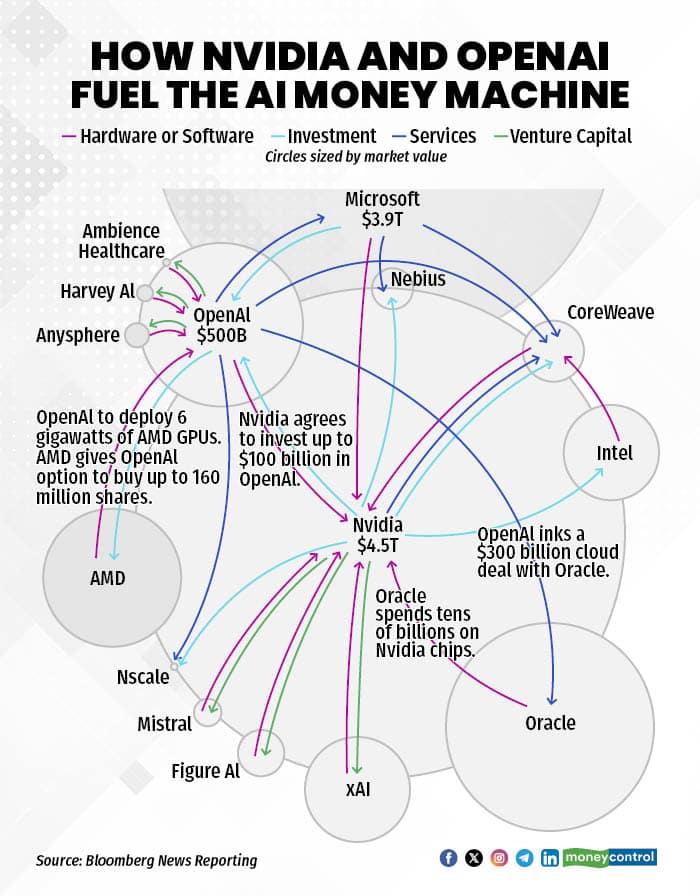
As well it should be with the so-called “AI” industry burning money far faster than it’s earning it—resulting in a desperate struggle to convince literally anybody to buy what it is selling. As fast as possible, too, since much of the investment being put into the so-called “AI” companies listed above is merely the same money being circulated between several of them over and over thanks to a daisy chain of interlocking ownership arrangements.
Much of the hype in question being built on the myth that these companies are on the verge of creating the aforementioned machine god. And that the imposition of artificial generative intelligence (the limited new so-called “AI” technologies that currently exist) into every aspect of daily life and thence the genesis of artificial general intelligence are therefore inevitable. None of those conceits being true.
All of which may soon result in the massive speculative bubble thus built up around so-called “AI” tech collapsing spectacularly when investors finally realize there will be no machine god emerging from the dominant tech in play, artificial generative intelligence, and rush in to recoup whatever money they can.
Think I’m kidding? In a 2025 Association for the Advancement of Artificial Intelligence (AAAI) survey of 475 top AI researchers, “The majority of respondents (76%) assert that ‘scaling up current AI approaches’ to yield AGI is ‘unlikely’ or ‘very unlikely’ to succeed, suggesting doubts about whether current machine learning paradigms are sufficient for achieving general intelligence.”
Meaning that the leading researchers in AI do not agree that the approach to developing artificial general intelligence pushed by so-called “AI” CEOs/sociopaths like OpenAI’s Sam Altman—claiming that scaling up with “bigger, faster, more” chatbots and chips and data centers equals machine god—will work.
So I truly believe that if Gov. Healey wants to take a long view on investing public funds in technologies that will be most likely to benefit the people of Massachusetts, then she should listen to well-informed researchers like Bender and Dettmer—together with data culled from a series of open and transparent public listening processes over the coming years—then focus on backing technologies that have the best possibility of improving the lives of ordinary working families over the coming decades.
Rather than gambling the Bay State’s future prosperity on a dangerous line of products created by greedy Silicon Valley hucksters trying to gin up the next big tech bubble to increase their own wealth and political power. No matter how many people’s lives they ruin on the way to potentially wiping out our economic future when that bubble inevitably bursts.
Postscript: It’s also worth asking whether it’s better to spend tax revenue on eminently untrustworthy corporations for research and development that could be done directly by state and federal government in the public interest, but that’s a discussion for another day.
Apparent Horizon—an award-winning political column—is syndicated by the MassWire news service of the Boston Institute for Nonprofit Journalism.