

Jordan Gomes waited for years to enroll in an alternatives to violence program while he was incarcerated at MCI-Shirley. He thought the experience could help him honor his commitment to never return to prison once he was released.
After speaking with one of the program’s facilitators, he secured a spot in the group. But his excitement was cut short when he received a letter from the programming director.
“I was told that I could never get into this program,” Gomes said in an interview. “It’s not going to happen.”
He was just one of the thousands of incarcerated people in the Bay State on waitlists for programming that could help them rebuild their lives after release.
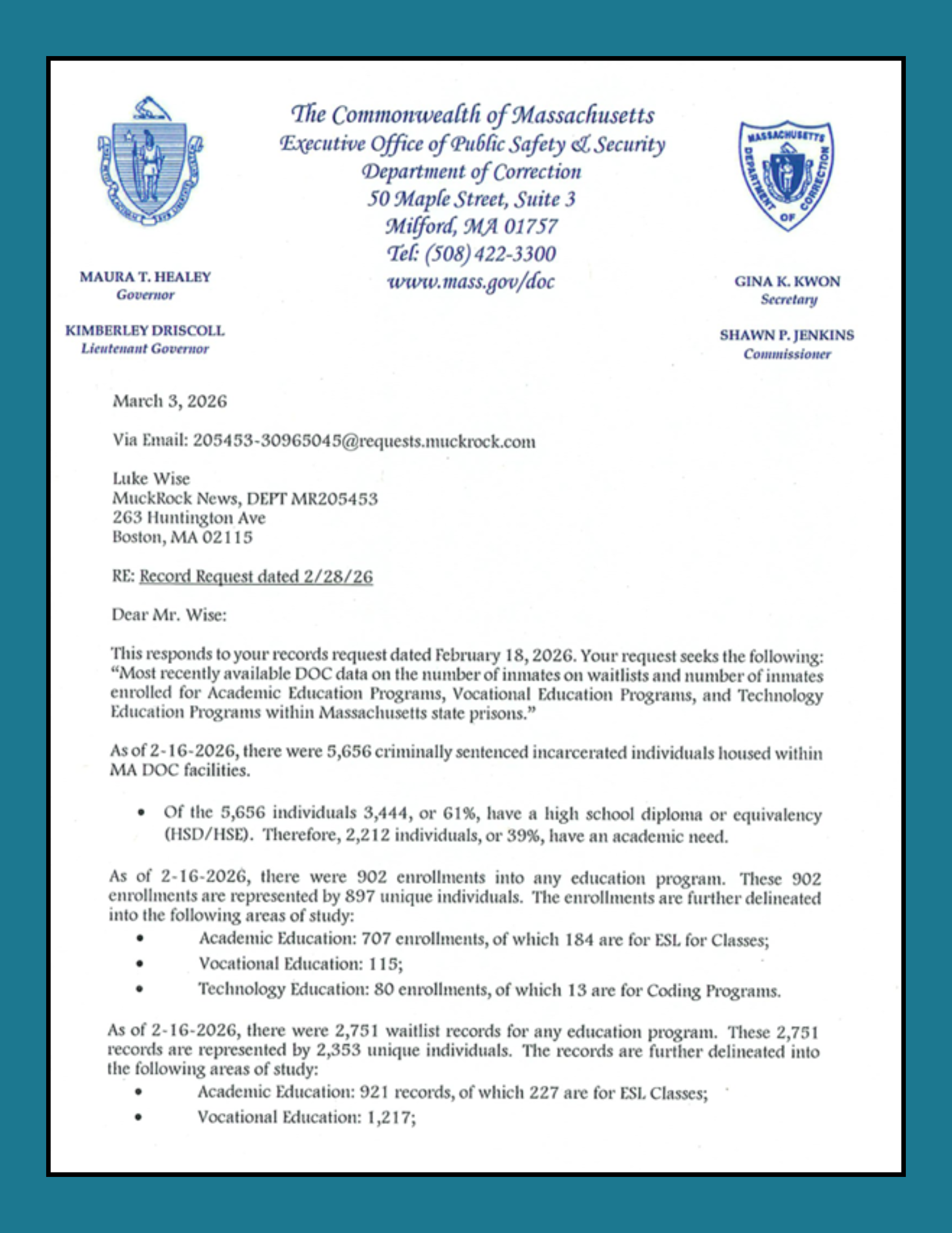
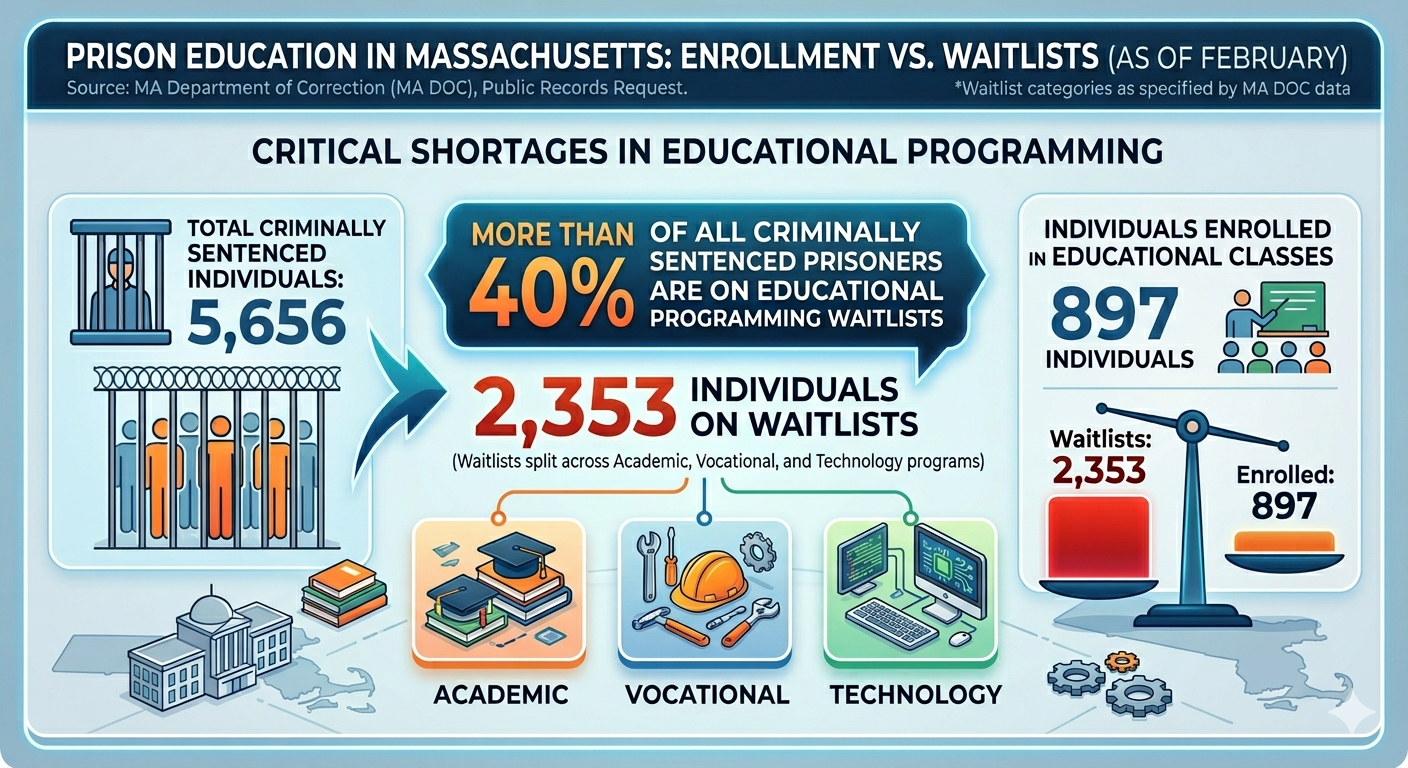
According to data obtained through a public records request filed with the Massachusetts Department of Correction, as of February, there were 2,353 individuals on waitlists for educational programming in Massachusetts prisons, split across academic, vocational, and technology programs. At the same time, there were just 897 individuals enrolled in educational classes.
Those figures represent a decrease from the more than 3,000 individuals on waitlists in 2022. That’s according to data from a records request made that year by Mary Valerio, an activist associated with the Actual Justice Task Team of the Southern New England Conference of the United Church of Christ.
Still, out of the 5,656 criminally sentenced individuals that are incarcerated in Mass DOC facilities, more than 40% are on educational programming waitlists. Those numbers do not include those on waitlists for other options, such as the violence alternatives program Gomes hoped to enroll in.
Massachusetts taxpayers spend around $134,000 per year on each incarcerated individual. According to Jesse White, a legislative director at Prisoners’ Legal Services of Massachusetts, a Boston-based nonprofit that provides civil legal services to incarcerated people, that should be “more than sufficient” to ensure access to education and re-entry programs for everyone.
“The vast majority of its funding goes toward punishment-related costs,” White said. “Instead of toward programming, education, vocational training, and things that would actually help to make the prisons and our communities safer.”
In a written response to an inquiry about programming access and high waitlist numbers, the DOC maintained that the volume of incarcerated learners seeking programming indicates the quality of their offerings.
“The strong demand for programming reflects the value of these opportunities, and the Department remains committed to building on that work through in-person instruction, virtual learning, and partnerships that expand access,” a DOC spokesperson wrote in an email.
Are programs working?
For the lucky ones who make it off of a waitlist, the programs they enter are often insufficient and a superficial “check off the box,” Gomes said.
An incarcerated person’s programmatic path in Massachusetts hinges on the Correctional Offender Management Profiling for Alternative Sanctions (COMPAS) system, he added. Gomes described the COMPAS assessment as the basis for a “success plan” tailored to each individual based on their sentence length, reason for incarceration, and perceived security threat.
The COMPAS system incentivizes participation in programming by promising eventual sentence reductions and facility transfers through good behavior, a model that promotes hollow compliance over active learning.
“You don’t get any benefit from these types of programs,” Gomes explained. “It’s just, Let me just get this [done], so that I can move throughout the system.”
Gomes said that learners often felt disconnected from programs without any element of “like-mindedness.” When staff who had never experienced addiction led recovery programs or textbooks oversimplified the paths that led people to prison, the curriculum failed to resonate, he added, saying the incentive system prioritizes enrollment over gaining real skills or knowledge.
“This is why you have this herd of people on a waiting list, trying to get signed up—it’s very competitive,” Gomes said. “And then when you go see these programs, there’s nobody in attendance. It’s like, What is going on here?”
With the addition of tablet-based learning to every Massachusetts correctional facility in 2024 after a July 2022 pilot program, access to education programs could see further expansion, but also risks becoming less individualized. In more restrictive facilities like Souza-Baranowski Correctional Center, educational programming is offered primarily—and in some cases, exclusively—through tablets.
“It’s far less interactive and beneficial than congregate group programming that has a facilitator,” White said.
A 2024 DOC tablet study tallied more than 6,850 hours of training for vocational careers in HVAC, plumbing, appliance services, and electrician work. Even so, vocational training remains one of the most inaccessible programming areas, with 1,217 waitlist records and just 115 individuals currently enrolled in courses across state correctional facilities.
Individuals are permitted to be on more than one vocational education waitlist at a time, the response to our February public records request noted. However, once a learner completes a vocational program, they are removed from any other vocational waitlists they had joined—indicating that they must start over at the bottom of the queue if they want further training.
The DOC employs 83 education professionals across their facilities and provides programming “within the current infrastructures available,” the DOC spokesperson said in their written reply. In its reply, the department spokesperson noted that for individuals who decline participation in programming, their waitlist spots are maintained “to support continued outreach and reengagement.”
Waitlists for programming do not operate on a first-come, first-served basis. Factors on an incarcerated learner’s COMPAS plan, like sentence length, can determine whether someone waits for months, years, or indefinitely to enroll in a program, Gomes explained. In his case, he said that he was repeatedly denied enrollment in the alternatives to violence program because of his lengthy sentence.
Working around the waitlist
In Massachusetts correctional facilities with inaccessible or inadequate programming opportunities, peer-led and volunteer-sanctioned programs have proven successful where they are permitted to exist, White said.
After years of languishing on waitlists and receiving denial after denial to traditional programming, peer-led programming offered a path forward for Gomes. At MCI-Shirley, he participated in and eventually helped lead two peer-led programs sanctioned by the facility: Toastmasters, and the Long Termer’s Group.
Before the COVID-19 pandemic, the facility’s Toastmasters club—part of the international public speaking nonprofit—was mostly volunteer-run. It has since become largely peer-led, Gomes said. The Long Termer’s Group has been peer-led since its inception.
Without perks like reduced sentence time or facility transfers, “You get out of it what you put into it” when it comes to these sessions, he said. Despite lacking traditional incentives, peer-led groups were almost always full and were regularly forced to turn people away at staff’s request.
“We probably have the best metrics as far as rehabilitation—guys who don’t get in trouble [and] guys who keep each other accountable,” Gomes said. “It was one of these things where it’s like, If we can do this in here, we could do this anywhere.”
Officially sanctioned peer-to-peer programs are only available at certain facilities, and the DOC has not allowed their expansion into prisons where they don’t already exist, White said. Such grassroots organizations are subject to skepticism and scrutiny from the DOC, and any activity outside of a group’s designated meeting space must be applied for and approved through the chain of command, Gomes said.
“We had to be more professional than the professionals,” Gomes said. “We were always doubted. We were always devalued and belittled in a way.”
Gomes described leading and participating in peer-led programs as one of his “proudest moments.” He cited the programs as the leading reason he never returned to prison after his release.
A path forward
Last month, Prisoners’ Legal Services and six other advocacy organizations authored a letter supporting six “common sense” bills that would support survivors of violence, improve confinement conditions in Massachusetts prisons, expand access to carceral programming and education, and create reasonable release pathways for incarcerated elders.
The letter, which 111 organizations signed, was sent on March 11 to the Massachusetts House and Senate Committees on Ways and Means, Speaker of the House Ronald Mariano, and Senate President Karen Spilka.
One of the bills would create universal access to at least six hours of programming a day, five days a week, for all incarcerated individuals in Massachusetts. It would also guarantee access to educational and vocational training, she added.
If passed, the coalition of bills would also save at least $25 million per year in the Massachusetts fiscal budget by creating pathways for elder parole, White said. Incarcerated elders are both the least likely population to recidivate and the most costly population to incarcerate, she added.
Extra resources could be invested in programming, education, and other areas that are proven to support re-entry and lower recidivism rates.
“In Massachusetts, you can see that the correct response is to increase programming, education, vocational training, [and] out of cell time,” White said. “These are the things that will break cycles of violence, will reduce harm overall, and will pave the way for people to re-enter communities successfully.”
Around 95% of all state prisoners will eventually be released, according to a United States Bureau of Justice Statistics report. A lack of investment in the future of incarcerated people could harm Massachusetts communities at large, Gomes noted.
“These are people who are going to be bagging your groceries… these are people that are going to be around you,” he said. “Why would you not want to also open up your mind to having a safer community by making sure that the people who are supposed to correct are held to a standard?”
Ed. Note: A previous version of this story mistakenly noted that “out of the $800 million-plus Massachusetts Department of Corrections (DOC) budget, only around 2% goes toward programming, education, and vocational training.” A DOC spokesperson responded with the following statement: “Under the definition of programs and treatment utilized for the Commission of Correction, we spend $100,876,482 which is 12% of our budget.” We regret the error.