Between 2023 and 2025, more than $113 million was disbursed to Massachusetts cities and towns to remediate the scourge of opioids. According to records obtained by the Boston Institute for Nonprofit Journalism, through last June municipalities had only collectively spent $19.8 million, or about 17% of those funds.
The money is cut from a tranche of settlements won from pharmaceutical companies like Purdue Pharma and others in the supply chain such as CVS for their role in fueling the country’s drug crisis, resulting in innumerable deaths.
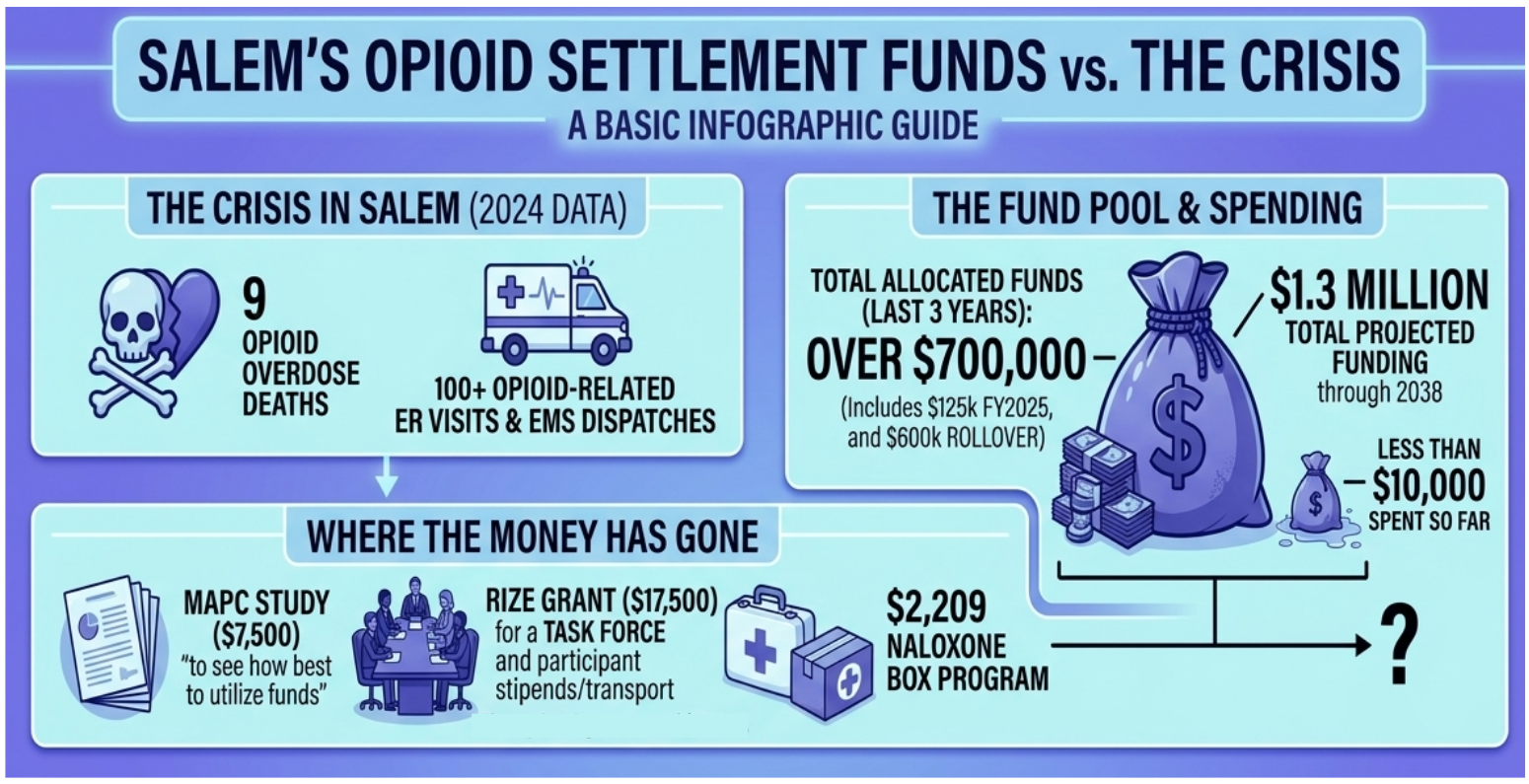
BINJ is investigating the use (and non-use) of opioid settlement funds, including in cities like Salem. In 2024, the Witch City saw nine opioid overdose deaths and more than 100 opioid-related emergency room visits and EMS dispatches. Yet it is among the cities in the commonwealth that have barely used remediation dollars despite having a clear need for it, having spent about $10,000 (roughly 1.3%) of more than $700,000 allocated in the last three years.
The high price of planning
Salem is slated to receive as much as $1.3 million in opioid settlement money through 2038. According to state records, the city received $125,000 in Fiscal Year 2025, with nearly $600,000 in unused funding rolling over from previous years. Its sole expenditures through the program so far have been $2,209 to the Illinois Supply Company for a “Naloxone Box Program,” and $7,500 to the Metropolitan Area Planning Council, a local planning board, for a study “to see how best to utilize opioid settlement funds.”
The resulting MAPC report recommended four areas for spending: housing, community engagement, a youth center, and employment. In an interview with BINJ, Salem Health Agent David Greenbaum said $1.3 million isn’t enough to address housing, and that funding a youth center may dissuade children from “going down the path of using substances.”
And the planning continues. The city was recently awarded an additional $17,500 grant from RIZE Mosaic, a contractor funded by the Mass Department of Public Health Bureau of Substance Addiction Services to administer these funds. That money is going towards an opioid settlement task force to “provide guidance on allocating funds and ensure spending reflects community priorities.” Greenbaum said there is no timeline for the effort, but ideally the panel will be formed by July, with money awarded by RIZE serving as stipends for participants and to cover transportation costs.
Displaced and disregarded
Kai is an unhoused person from Salem who uses injection drugs. Told about settlement spending priorities in her native city thus far, she laughed in frustration at the idea of using tens of thousands of dollars for studies and task forces “discussing” expenditures. Instead, she said they should be helping people like her.
“How about they just fucking start using it and stop discussing it,” said Kai, who requested that we use her street name. “Salem needs a methadone clinic, maintenance programs, a Suboxone program, Vivitrol, [and] after care from those maintenance programs once you come off of them.” She also emphasized the need for transportation to these resources when people can’t get approved for free rides through MassHealth.
“Some people can’t get the Ride to Lynn, or Saugus, or Peabody,” she said. “Then they’re relying on the buses or the trains, and they don’t got money for that.”
Kai used to stay in Salem’s South River encampment, but that area was cleared in the summer of 2024. She said that police “realized they fucked up” after they shut the camp down, since the substance use of residents use was no longer hidden in tents. The ensuing harassment from local authorities forced her to the hard pavement of Lynn’s old MBTA garage where she now sleeps.
“Everybody was smoking crack and shooting dope out on the sidewalks and didn’t give a shit; we weren’t behind closed doors in our tents.” Kai explained that she and her peers wound up in neighboring Lynn due to pressure from Salem police. “They realized they had a big problem, and so then [police] started really coming down on us hard, harassing us when we weren’t even doing anything.”
The role of police in opioid remediation
Guidance from the Department of Public Health discourages municipalities from using opioid settlement money to fund law enforcement. Greenbaum said Salem’s Board of Health will “try to abide” by those recommendations.
So far, the Salem Police Department has not received opioid settlement funding, though its Community Impact Unit already plays a major role in the city’s overdose response. The department holds overdose response trainings for the local shelter, and in collaboration with the cop-run Essex County Outreach program, the CIU does outreach to people who use drugs.
To the north in Lawrence, last year officials used $77,564 in remediation funds for police “outreach to encampments,” while the Lowell Police Department allocated $20,000 to assist in the purchase of supplies related to opioid users.

Analysis paralysis
In response to claims that Salem has a lack of urgency on these issues, Greenbaum said the city’s hesitancy is due to wanting to use the funding correctly.
“We want to make sure that we’re putting this money in the places that are going to impact the most people in the best way possible,” Greenbaum said. “We don’t want to just be spending money, we want to make sure it’s going to have the greatest impact for the most people.”
Salem Ward 6 City Councilor Katelyn Holappa spoke to BINJ about the logjam, saying that she often “hates studies.”
“I’m not directing this at anyone in particular, but I feel like a way to say you’re working on a solution to a problem you have no intention to solve is to say you’re doing a study about it.” The newly-elected progressive continued: “I’m much more in favor of experimenting rather than taking 10 years to try to guess whether you’re going to do something and then being wrong because your data was from 10 years ago when you started the study.”
“Just try something,” Holappa said. “Did it work? No? Pivot.”