In a BINJ.News editorial last week, I found myself doing a fast analysis of the various factions I see that are for or against the US and Israeli war on Iran. My purpose was to invite people active in those factions to send in opinion articles reviewing why they have arrived at the positions they support. But the simple act of writing down how many factions there are, reminded me of one reason that we’re not seeing the emergence of a powerful antiwar movement in the US: The whole situation is hard to understand.
Not to say that believing it was outrageous for the US and Israel to violate international law and common decency in launching the war in the first place requires much in-depth knowledge. An immoral act is as obvious to the average American as it is to any other average person anywhere on the planet. But the waters get muddy quickly when trying to decide which faction to back. And some Americans do support the already unpopular war—either because they are Iranian refugees and descendants of Iranian refugees who hate the current regime in Iran or because they are such dogged Trump boosters that they’ll go along with pretty much anything he decides to do.
Then yesterday, I was meeting with one of BINJ’s (30!) interns and in the midst of explaining the way famed Japanese filmmaker Hayao Miyazaki portrays Europe in many of his animated movies, I remembered that two of the films that make use of fictionalized European landscapes, “Howl’s Moving Castle” and “Porco Rosso,” are also antiwar films.
And to my mind, “Porco Rosso” is among the greatest antiwar films ever made. Up there with “Dr. Strangelove,” “Apocalypse Now,” the various versions of “All Quiet on the Western Front,” and “Grave of the Fireflies” (an anime by Isao Takahata produced by Miyazaki’s Studio Ghibli), among many others I could mention.
But “Porco Rosso” (“Red Pig” in Italian) doesn’t hit you over the head with its politics. It’s set in Italy between world wars. Its main character is a former military pilot who has turned into a pig for reasons never fully explained. Its antiwar stance is subtle (as is its anti-fascism … until its eponymous main character utters the famous line “I’d rather be a pig than a fascist” at least). It starts off as a goofy children’s movie with lots of fun action sequences involving “air pirates” and dogfights between same, where the stakes are low and no one really gets hurt or killed.
But the movie gets more and more serious as fascism begins descending on Italy. And there is one scene that crystalizes its politics definitively in the antiwar camp: when Porco Rosso tells his young assistant why he thinks he became a pig.
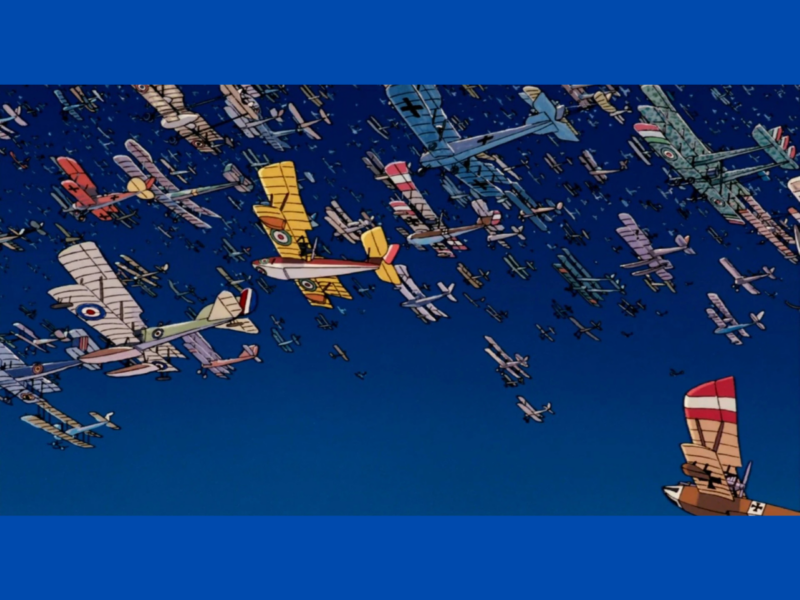
He talks about being a pilot in the Italian air force on a routine patrol in the last summer of World War I. His unit suddenly finds themselves in a fight for their lives with an Austro-Hungarian unit. He’s the only Italian to survive and is still flying for his life when he has a vision of his plane flying itself above thick clouds. Far above him, he sees a sparkling band of white arcing across the sky into infinity. Then the pilots from both sides who he had just seen die fly past him toward the white band, not saying a word, staring straight ahead. Including his best friend. And he shouts to his friend that he wants to take his place; so his friend can go back to the woman he just married. But Porco’s plane won’t respond. And he realizes that the white band is made up of a vast number of planes from all nations. All killed in the war.
The scene makes it quite clear through visual storytelling that their deaths were utterly pointless and tragic (you can see the scene for free here, starting at minute 1:04:32).
The film itself has a fairly happy penultimate scene in which most of the issues that make up the more obvious plot of “Porco Rosso” are resolved in a way that kids can enjoy. But the final scene is more like the end of a film noir than a children’s movie. I won’t spoil it for anyone who hasn’t seen it, but suffice to say the deeper plot that one might call the film’s real narrative is left unresolved.
And what is that plot about? War versus peace and fascism versus democracy. And each individual’s responsibility to fight injustice whatever the personal cost.
While all this was running through my head, my conversation with my intern had turned quickly to other matters. But I kept thinking about why I was suddenly struck by that “Porco Rosso” scene out of the blue. And I realized that it relates strongly with the problematic that has been gnawing at me since I wrote that editorial seven days ago: Why isn’t there a larger stronger antiwar movement? Even though the Iran War is more complicated than many conflicts.
It’s a question I’ve been asking myself for my entire adult life since the US has been in a string of wars and “military actions” from the moment of my birth in the mid-1960s—and I’ve been opposed to war since I was a teenager.
Then a related problematic surfaced as I thought more about “Porco Rosso:” With so much popular culture that’s antiwar—movies, art, music, and more—why has it failed to reach people? Is it too depressing or esoteric a topic to too many? Do people ignore antiwar culture?
Part of the issue might be that most works of art across all media contain different levels of meaning. As with “Porco Rosso,” where there’s kind of a fun level aimed at younger viewers and a more serious level aimed at deeper thinkers of all ages. Many people, many adults included, watch movies to relax and can do that with the “pirates and cool planes” plot of “Porco Rosso.” And perhaps they do just ignore the bigger themes at play in the film, I can’t know how millions of people encounter any particular work.
But upon reflection, I think that we just need more culture that questions why the US (and many other nations) are at war all the time. I think there has never been enough of antiwar culture because it’s very difficult to get financial backing for such projects. And I think that maybe the route to a strong antiwar movement lies in the production of more antiwar cultural works … and works of journalism for that matter. We need more culture like “Porco Rosso,” not less.
So, workers in the creative professions, consider this a challenge: Despite the manifold threats to the livelihoods of our filmmakers and actors and artists and musicians and dancers (etc., etc.) posed by social media and so-called “AI” and late-stage capitalism itself, if you agree that war is bad for humanity, then find a way to embed your antiwar beliefs in the cultural works you create. And do it in ways that any person from any walk of life can understand. Like Hayao Miyazaki has done it for decades.
Doing that might have some positive effects on a number of critical debates of our time, like whether or not the US will remain a democracy, I shouldn’t imagine. And it may help create the groundswell of public opinion needed to stop stupid conflicts like the Iran War from starting in the first place. That is my deepest wish anyway.
Apparent Horizon—an award-winning political column—is syndicated by the MassWire news service of the Boston Institute for Nonprofit Journalism.