When Hilde-Kari Guttormsen read a scientific report from her alma mater, the University of Bergen, revealing the discovery of 2,000 to 8,000-year-old stone carvings in Western Norway, something caught her eye.
Amid scenes etched into the rocks depicting men, weapons and hunting was an animal carrying a baby inside it, whose head lay right where the mother’s heart would be.
With so few women represented in the carvings, Guttormsen said she found the image to be “stunning,” and it left her wondering what mark she can make on the world as a woman and artist.
“These people left behind for me to see, thousands of years later … that little baby inside the mom,” she said. “And I felt, ‘What can I leave behind?’”
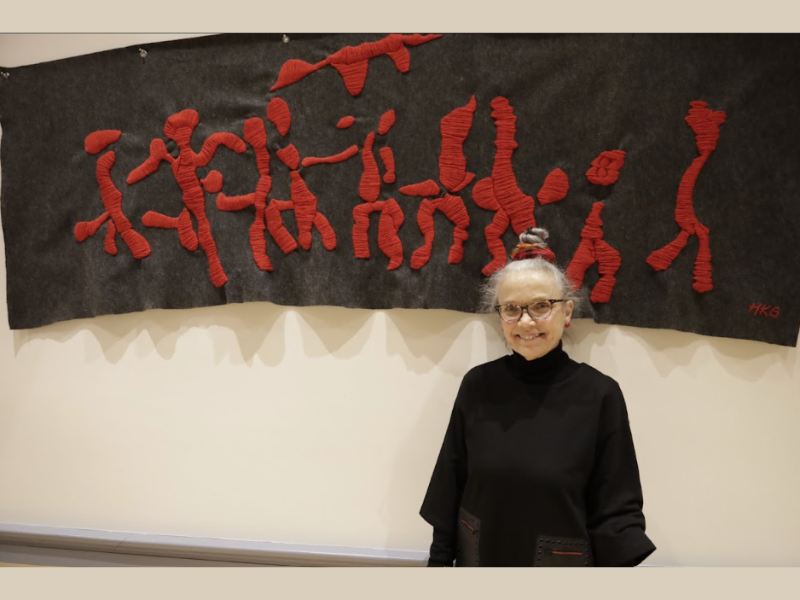
For her latest exhibition, titled “Portals,” Guttormsen used the figures from the scientific report as inspiration, with the motherly animal acting as the centerpiece.
For each piece, she said she used an arrowhead-shaped needle to pull the canvases’ tightly woven threads from within to create an embroidery that protrudes from the surface. The works are featured in the Nordic Hall exhibition space of the Scandinavian Cultural Center and Library, located in Scandinavian Living Center, an assisted living facility in West Newton.
In the back of the room is an embroidered banner, casting a wavy shadow below it, which Guttormsen said mimics the pattern of the granite on the island where the carvings were found.
“Portals” will be on display at the center through February.
Hilde-Kari Guttormsen is a 67-year-old artist from Bergen, Norway, who resigned from her job as a Harvard researcher in 2011 to pursue her lifelong dream of creating art that resonates with the female experience.
When she was a kid, she said she traveled across Europe and noticed that in every town square, there was a monolith that took a “male form.” This led her to ask a question she would later explore in her own art: “Where are the female models?”
“It’s always something I want to draw attention to, and then people might not [even] see it,” she said. “But, I can’t do anything [about it]. All I can do is provide the art.”
Guttormsen currently lives in Brookline and works as a full-time studio artist at Lincoln Studios, one of three venues for Waltham Open Studios, which represents more than 90 artists.
Lincoln Studios, located on Moody Street in Waltham, was originally a Jordan’s Furniture store, but was bought by local artist John Thompson and turned into an art store, she said.
Several years ago, Thompson grew sick and had to sell the store, she said. Although the store “couldn’t survive,” the building remains a learning center where sculptors, painters and other artists, like Guttormsen, continue to create.
“There’s so much history in the walls there, and … now, we have lots of young people coming in,” she said. “It’s a living community. It’s a life force.”
Guttormsen said she grew up in Norway, engaging with many different arts: she viewed, created and read about art, took metalworking, woodworking and music classes at her junior high school and even joined a film club.
Despite this, she “never thought of becoming a visual artist in those years,” she said.
When she was 18 years old, Guttormsen began attending the University of Bergen to pursue a degree in medicine. Afterward, she completed a year-long internship and residency, or postgraduate training, then got her first medical job as a summer doctor.
There, the medical department offered to write her a letter of support for a competitive PhD program, which she ended up getting accepted into.
While pursuing her PhD, she had the opportunity to travel around the world, including to Berlin, Germany, where she attended a scientific conference and presented research on meningitis bacteria.
At the conference, she met Lee Wetzler, then a student at Rockefeller University in New York, whom she fell in love with and later married, she said.
After completing her PhD in 1993, Guttormsen moved to Boston with Wetzler, where she worked as a research fellow and assistant professor at Harvard Medical School, and he worked as a professor in Boston University’s medical science graduate program.
Although her work at Harvard was among the “most fun” she’s ever done, she didn’t like the workplace culture, she said.
“It’s like a boys club,” Guttormsen said. “Everything is decided before you get into the meeting. Someone has made the decisions, and you are not part of it.”
Additionally, she said, when she was pregnant with her first child of three, she was only given her paid sick and vacation days for maternity leave.
“They had a nerve, Harvard, to say that was maternity leave,” she said. “I told [them], ‘Well, I think every un-pregnant male has maternity leave then, because they get paid sick days, and they get paid vacations.’”
For these reasons, she said she decided to pivot careers, leading her to attend Massachusetts College of Art and Design in 2011 to pursue her lifelong passion for art.
“I knew my people were at MassART,” she said. “I’d gone over there and had lunch every now and then, and I knew that was more my crowd than the Harvard Medical School.”
When she attended MassART, she said she tried to take more courses than the college allowed. She took so many classes that the school introduced a new rule that students had to pay extra if they wanted to take more credits in a semester than what was required, she said.
“They wouldn’t let me do a triple major. They don’t let you do that,” she said. “You can’t do two 2Ds at the same time, but I cried my way into doing that too.”
Guttormsen said at times she was harshly criticized by the school because they didn’t like her art.
“They didn’t like my materials [or] what I was doing. I used cement a lot,” she said. “They didn’t understand what I was trying to do.”
Guttormsen said one of her art pieces, a commentary on catcalls titled “Do You See Me Now?”—a pink life-sized doll hanging from the ceiling—left three female professors looking “shell-shocked.”
“I was so fed up with catcalls coming up,” Guttormsen said. “I walked up, or biked up, by Harvard and … there were always catcalls. And I had three girls. I didn’t want them to hear these kinds of catcalls.”
To conduct research for this piece, Guttormsen surveyed women across Boston to ask about their experiences being catcalled. She then printed out cards, some with black writing, documenting a catcall directed at a survey respondent, while other cards with red writing captured the underlying emotion attached to each incident.
The piece was included in MassART’s weekly rotating student gallery around 2015, where students were invited to add their own cards.
“When the show was done, you couldn’t see that she was pink anymore,” she said. “She was pampered with these little notes … And the response we got from people, from the students, they really reacted.”
Guttormsen said a lot of her art is unconventional and uses fun materials. For example, she said her piece, “Boats,” is composed of wall insulation foam, silk and plastic gimp.
Her next exhibition, she said, is a group show at the Art Gallery in SoWa, called “The Aclhemy of Art and Play,” which is slated to open March 6. Her art pieces being featured in the show are “Infinity Column,” a ring made of gimp and piano wire, and “Forever Fresh,” a plastic basket filled with hand-blown glass flowers.
She said she has no plans to retire and will continue to make art until her body no longer allows it.
“I’m so happy,” Guttormsen said. “And I don’t ever need to retire. We have all these fantastic female artists who worked until they couldn’t hold anything in their hands anymore, or were too sick to work.”
This article was produced for BINJ.News, the independent weekly magazine published by the Boston Institute for Nonprofit Journalism, and is syndicated by BINJ’s MassWire news service.