
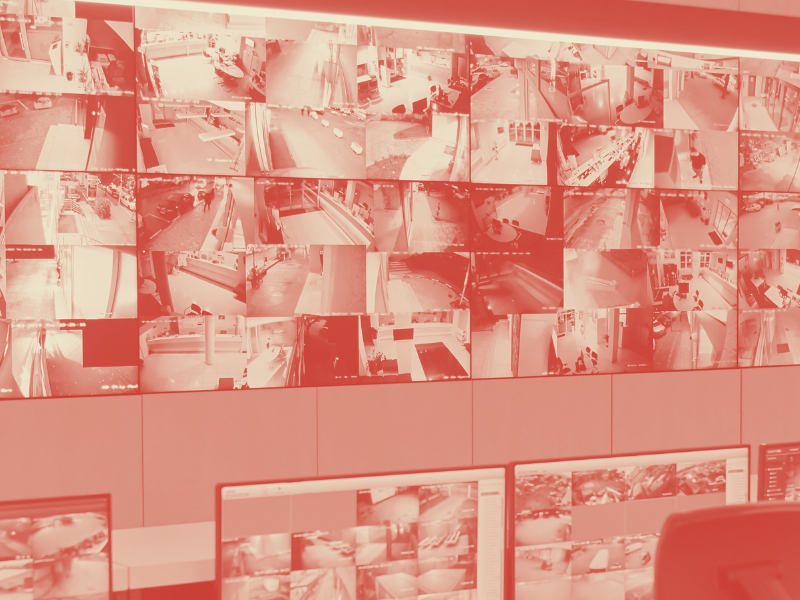
One apparent paradox of the modern American police state is how people fear Big Brother on the big screen yet don’t recognize how doorbell cameras are part of the matrix. I don’t really disagree with cynics who at this point have abandoned any real expectation of privacy, and even sympathize with those who are willfully blind to the thousands of robotic eyes that we pass by in public on any clear day.
But seriously, folks, it’s time to pay closer attention.
One vignette that may cause you to stir awake in bed at night sweating and trembling comes from Alex Marthews of Digital Fourth, a volunteer-run campaign that impugns unconstitutional government surveillance. It’s from an article that 404 Media reported deep in the red heart of America, but it involves a company that recently set up shop in the Hub and has its literal eye in the sky over Mass.
“In May, a police officer in Texas heard from the family of a woman who had driven out of state to obtain an abortion.” Marthews and fellow vols offered the cautionary tale to members of the Cambridge City Council earlier this year, as they were reviewing their city’s contract with Flock Safety. He continued …
“To find where she had gone, and to determine whether she should be charged with a crime, the police officer searched Flock’s entire nationwide network of 89,000 cameras, including those already deployed in Massachusetts.”
But wait, it gets worse: “Once it came to light that they had done it, the police department lied to the press about why, saying that they had only been concerned for her safety.”
Here’s the Electronic Frontier Foundation explaining how such an outrageous invasion of privacy was made possible: “Flock Safety provides ALPR (Automatic License Plate Reader) technology to thousands of law enforcement agencies. The company installs cameras throughout their jurisdictions, and these cameras photograph every car that passes, documenting the license plate, color, make, model and other distinguishing characteristics. This data is paired with time and location, and uploaded to a massive searchable database.”
You know where this is headed—directly at the Fourth Amendment: “Flock Safety encourages agencies to share the data they collect broadly with other agencies across the country. It is common for an agency to search thousands of networks nationwide even when they don’t have reason to believe a targeted vehicle left the region.”
Last month, EFF revealed how “more than 50 federal, state, and local agencies ran hundreds of searches through Flock’s national network of surveillance data in connection with protest activity”—including No Kings demonstrations. “In some cases, law enforcement specifically targeted known activist groups, demonstrating how mass surveillance technology increasingly threatens our freedom to demonstrate.”
Mass is no exception. This sort of sophisticated mass surveillance is all the rage among tech investors and their enablers in public office, and Flock Safety, with its $7.5 billion valuation, is expanding. In the past year the company opened a 50,000-square-foot drone lab in Georgia plus a new Boston office that “will be home to roles across sales, engineering, customer success, and beyond, with plans to add 150 net new jobs in the area over the next two years.”
“We’re excited to open a space where our people can come together, collaborate in real time, and spark the kind of innovation that drives meaningful impact,” Flock Safety’s chief people officer said in a statement. “Boston’s incredible ecosystem of talent and technology makes it the ideal environment to fuel our next chapter of growth.”
Talent isn’t all they’re scoping. The City of Boston entered a pilot contract with Flock in 2024, while the company’s cameras are also in Brookline and Watertown. In the latter, the lack of any real oversight process for funding the Flock equipment has caused a major rift among city councilors and calls for reform from the public.
Part of the outrage over Flock Safety’s aggressive tactics, not just in this region but across the country, stems from the people behind the brand, their political ties, and the implications of it all. For starters, Andreessen Horowitz is a major investor. Here is ProPublica reporting on how the company’s tech billionaire namesake “bet big on Trump”: “It’s paying off for Silicon Valley. … The Trump administration’s gutting of the Consumer Financial Protection Bureau has been good for venture capitalists like [Marc] Andreessen.”
As Digital Fourth highlighted, Flock Safety “recently revealed that it has a contract with Customs and Border Patrol (CBP) and shares ALPR data without the consent of local officials. … It was also revealed that they had been sharing data with ICE, Homeland Security Investigations, the Secret Service and, for good measure, NCIS.”
We are accelerating down a dangerous path with these developments. But it is possible to push back, as residents and even law enforcement have done in select places. Digital Fourth notes how, “due to the company sharing data in violation of Illinois law,” that state recently terminated its contracts with Flock. Similarly, Eugene, Oregon “paused its Flock deployment as a result of privacy concerns.”
The Cambridge contract befell a similar fate. In October, the city removed 16 Flock ALPRs due to “data privacy and security” concerns. As a follow up, the city issued the following statement this month: “Concerns about Flock were substantiated when they notified the City that two cameras were installed by their technicians in late November — without the City’s awareness — following an outstanding work order that should have been canceled when the City originally deactivated the cameras and account. Due to this material breach of our trust and the agreement, the City is terminating its contract with Flock Safety. The two cameras have also been removed.”
Regarding the Cambridge incident, WCVB NewsCenter 5 reached out to Flock Safety for comment. They were told that “nearly 100 law enforcement agencies across Massachusetts utilize Flock Safety technology, and that each Flock customer ‘fully owns and controls 100% of its data.’”
Yeah, sure they do.