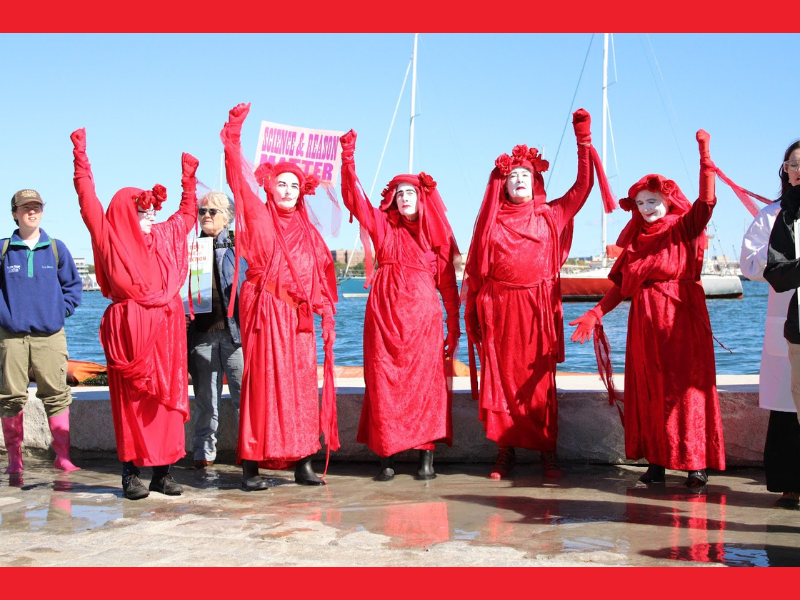
BOSTON – The specter of silent, red-robed figures walking around Long Wharf, faces a ghostly white, stunned Gwendolen Noyes, her hands outstretched in agony.
“I was thunderstruck … they just hit me, and I couldn’t figure out what was going on,” said Noyes, a housing engineer who lives in Cambridge.
This was Noyes’s first time seeing the Red Rebels, the silent, red-robed climate activists who have begun to appear around Massachusetts, drifting through high-traffic neighborhoods and climate protests to confront the public with the emotional weight of the climate crisis.
Originally formed in London by Extinction Rebellion activists Doug Francisco and Justine Squire, the Red Rebel Brigade uses a performance-driven approach to emphasize the climate crisis.
Climate change, the long-term shifts in the Earth’s average temperatures and weather patterns, is a natural process that has existed since the creation of our planet. However, human intervention has accelerated the process due to greenhouse gas emissions from over 150 years of burning fossil fuels.
In Boston, the stakes feel particularly high. Extreme heat waves and cold spells, coastal storms and flooding, and humidity changes that bring new, sometimes debilitating, diseases to the region are factors affected by climate.
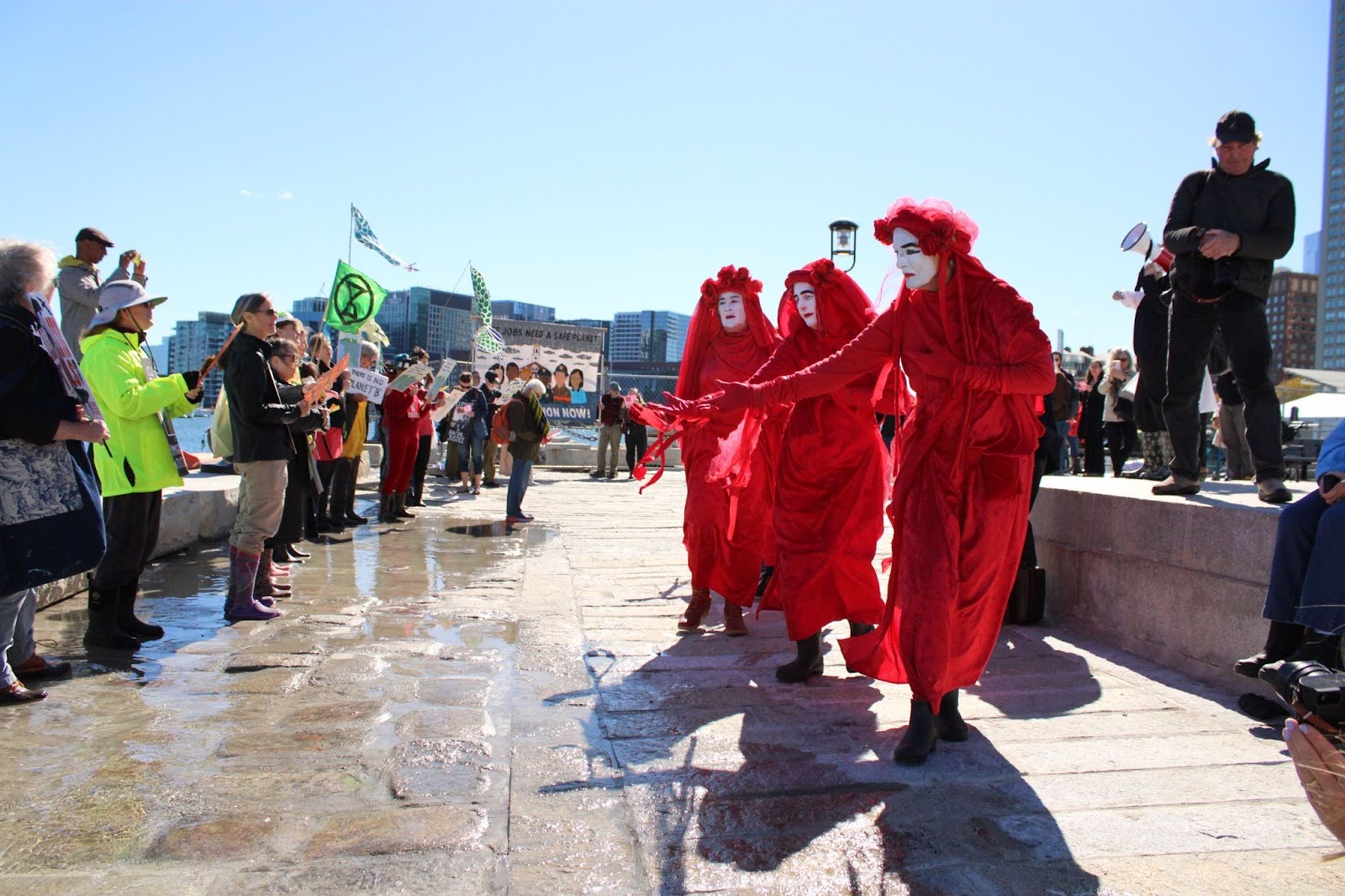
The Red Rebels joined the Extinction Rebellion to experience the high tide flooding the edge of Long Wharf. Flooding is one of the biggest climate concerns for Boston, specifically for waterfront neighborhoods and infrastructure. Photo by Chelsea Plunkett. Copyright 2025 Chelsea Plunkett.
Noyes has been vocal about these concerns for decades, from sharing Quaker pamphlets on eco-friendly living to joining grassroots environmental groups like the Sierra Club. But the urgency of recent climate reports has pushed her to try a new method of activism.
“I was … talking about it, and trying and doing everything I possibly could, and feeling like this is where people need to be hit about things environmentally,” Noyes said about her growing concerns about human-caused global heating.
Her frustrations with current climate messaging made the Red Rebel’s approach appealing.
“Trying to convey verbally something that is really something we need to take in our whole bodies … my health, my mind, my psyche, everything is all one, and when we’re only giving a message through our brains and our verbal stuff, we’re missing out,” she added.
The founder, Francisco also believes that activists shouldn’t have to argue for the very existence of the crisis they are protesting.
“I was tired of all the discourse and all the arguments, all these people wanting to debate … whether climate capacity is real or not … that’s kind of enough for me,” he said in a Zoom call from London.
And when activists have exhausted their capacity to speak out, silence can convey urgency without inviting further dispute, he said.
“If you don’t say anything, you can’t be misquoted,” Francisco added.
With local groups now sprouting up from the UK to North America, Boston is home to one of the most prominent Red Rebel chapters in the United States, a distinction Noyes says comes with some pressure.
“The Brits hold us to a standard that is very difficult to reach …” Noyes said, referencing the rich history Britain has with theater and acting. “I think they have a culture of performance that the Red Rebels are coming out of … it’s a standard that is pretty impressive.”
But this level of performance comes with the possibility of backlash from members of the public and various police forces alike. For example, in October 2025, the Red Rebels, with Extinction Rebellion, conducted a “die-in,” a form of protest where participants simulate being dead, outside of Chase Bank in Downtown Crossing, where some risked arrest.
“There were only two Red Rebels to do the mourning over the people who were pretending to have died from hurricanes, floods, fires … but there were … four or five activists (pretending to have died) prepared to be arrested …” said Jenny Allen, a Boston-based Red Rebel.
For Allen, these moments demonstrate how their presence can shift public perceptions on a matter, even without verbal confrontation.
“The bank did not react and the police did not come,” Allen said. “To me that says they recognize that what we’re saying actually has some legitimacy.”
However, some critics believe this approach to climate justice is too docile. In a 2024 letter to the Guardian in response to commentary by a Red Rebel, a UK reader named Patrick Cosgrove said he believes climate activism is doomed to fail. He noted a surge in purchases of cheap air fares for flights that add to climate change.
“Is dressing up in red having any effect on those air passengers?” Cosgrove writes, referencing a RyanAir price drop on tickets. “Of course not. Little if anything works in the face of corporate greed, government inaction and material desires that drive rampant consumerism. … The realistic choices are to either join in the party before everything collapses or quietly live in line with one’s conscience in the knowledge that it will make no difference whatsoever.”
But Noyes says that performance-driven protest methods still play a role in drawing attention to the climate crisis, even if its large-scale impact can be hard to measure.
“You have some kind of reaction to it. Not everybody does (react), but some people do, and I feel like we’re successful when people feel like this is not just something for our heads,” Noyes said. “This is something to take into our whole bodies, that the Earth is really hurting, and we can do something about it.”
This article was produced for BINJ.News, the independent weekly magazine published by the Boston Institute for Nonprofit Journalism, and is syndicated by BINJ’s MassWire news service.