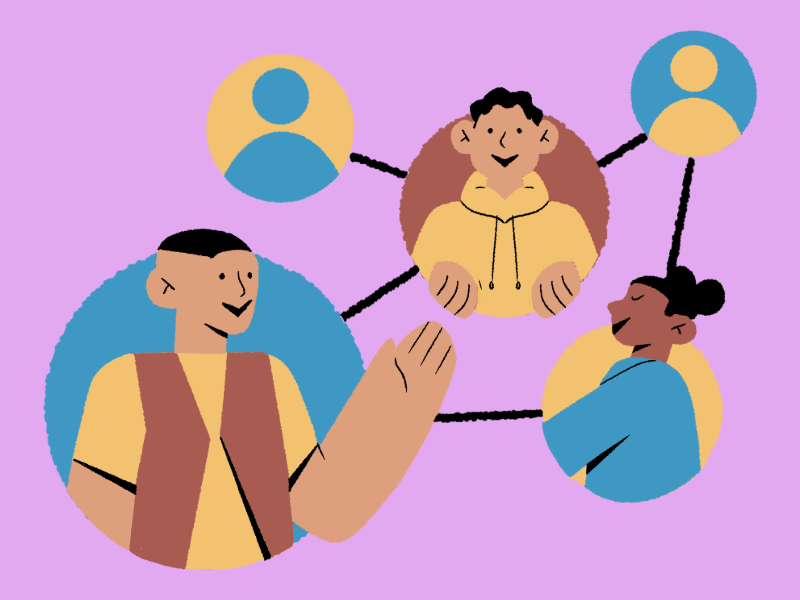
BOSTON – Whether you watch the morning news, mindlessly scroll on your phone during your commute or check in on LinkedIn, nearly everyone is surrounded by AI discourse, and there’s good reason for it. Generative artificial intelligence is quickly becoming one of the largest influences on pop culture and unexpectedly, the loneliness epidemic in the United States. Experts have yet to decipher whether AI mitigates the impacts of loneliness more than it causes it. However, what is clear is that AI has its sights set on the isolated.
OpenAI has determined that about 2.4 million users turn to ChatGPT expressing suicidal ideations or simply prioritizing talking to the generative chatbot over their loved ones.
The 2025 AI Index Report from Stanford AI revealed that in 2024, US private AI investment grew to $109.1 billion. These numbers are a telltale sign that AI companies are undoubtedly on the rise. Though such investment makes AI seems unstoppable, several coalitions and businesses in Boston are working hard to give their communities reasons to opt out of their phones and start developing more human connections.
Ending loneliness
Sandra Harris, co-founder of the Massachusetts Coalition to End Loneliness & Build Community, spoke about the nonprofit’s efforts to do their part. Harris cites that even when the coalition was starting out as a task force, there were commonalities among those who were showing up to the discussion groups. When it comes to loneliness and self-identifying as lonely, Harris mentions that many residents didn’t know the risks that come with being lonely.
“There were a number of people who just felt lonely but would not self identify, there’s a myth associated with being lonely or just saying you are lonely—there is a true digital divide.”
The coalition has focused on building awareness and finding ways to educate populations who aren’t up to date on technology’s advancements or its potential harm.
“It’s taking over our world, these people are going to be left behind. We have to find a sweet spot with technology.”
While much work is to be done Harris sees people rising to the occasion. “In six years we’ve grown the coalition from six members to 201—we have met monthly for the last six years on a Zoom call because it’s such a statewide effort. So the mere fact that people are coming to the table and people are coming to hear about the work to understand the impact of loneliness and trying to figure out ‘what can I do in my community?’ This requires everybody on the ground to solve this problem. I’m encouraged by people showing up for this work.”
Sept. 28 being officially recognized in Massachusetts as Good Neighbor Day was not the end for the coalition but the beginning.
“Good Neighbor Day was just a vehicle to say ‘we are neighbors, we need to make sure that everybody feels like they belong and they’re welcome in the community they call home. You know Good Neighbor Day is not one day it ought to be everyday in Massachusetts.”
Despite Harris’ preference for people to take walks in their local park, she recognizes that AI is something to be cautious of while not dismissing it entirely.
“I’m so ambivalent about all of that but it’s here and it’s taking off.”
“My mantra is technology is good but let’s use technology to strengthen human connections, not to replace human connections.”
Harris says being intentional and going out and talking with people is more powerful than people give it credit for. There are easy things that can be done, and yet the coalition is still getting creative. The Massachusetts Coalition is working to get people to install “happy to chat benches” to encourage interaction.
“It’s just the little things, little things have a way of growing and becoming larger things.”
Harris isn’t alone in her commitment to face-to-face connection. Across Boston, other organizations are answering the same call, each bringing their own approach to combating isolation.
Conversation cards
Nikki Shults, executive director at Everyday Boston, knows loneliness firsthand. From childhood to her time in the Peace Corps which left her feeling isolated both geographically and linguistically. The same type of experiences that drive the organization’s mission to bridge racial, social and economic divides through storytelling.
“We live in a world where we are deeply divided—whether it is politics, race, rural vs urban, age—and we’re still recovering from the pandemic where digital communication replaced a lot of face to face.”
At community events across the city, Everyday Boston’s “conversation cards” are used at “conversation stations”—inviting setups at local events that use prompt cards to encourage people to open up in a setting that relieves anxiety, rather than contributing to it. Shults shared that these cards create space for people who need someone to listen. Individuals who’d typically pass each other on the street realize there’s more in common than they imagined. The organization’s Story Share partnership brings together an unexpected pairing: older adults from the Veronica Smith Senior Center and formerly incarcerated individuals from the Bridge Project for quarterly gatherings that have become so popular that both populations request it repeatedly.
Everyday Boston offers workshops to help residents develop curiosity, confidence and the necessary communication skills to go out into the world and interact with strangers. For those who can’t get out, Shults acknowledges that even AI companionship might be better than complete isolation, though she’s cautious.
“I recognize for some people [going out and talking to strangers] that’s a really hard ask, and if you are a truly isolated person in your home and for a number of different reasons you’re not getting out, is that better than nothing? I think it is.”
Shults compared generative AI to social media—complicated, with clear downsides, but not without benefits.
Despite strong community engagement, Everyday Boston still lacks the infrastructure to meet demand. The nonprofit operates with a group of volunteers on standby, waiting for funding opportunities to expand. Still, Shults says the programs and initiatives they do offer are making an impact.
“Every Valentine’s Day we have our love your wicked awesome neighbor challenge, and two years ago we had community members make 1,000 ‘kindness cards’ that we handed out to strangers.”
With a humble goal of 1,000 kindness cards, over 11,000 were ultimately handed out.
“Similar to the conversation stations some people were like ‘aw this is really nice, thank you’ other people would receive a card and it was exactly what they had to hear that day, maybe they were feeling invisible or hopeless and helpless that getting a piece of unsolicited kindness from a stranger could change their day, change their outlook.”
When asking Shults what advice she’d give to those feeling stunted in their journey to find community, she’s reassuring, “The city puts on a lot of events and there are a lot of organizations doing work like this, there are a lot of low pressure ways to start getting involved. You don’t have to be a super engager at the beginning, just show up and keep showing up.”
Reaching isolated populations
While there are many groups on a mission to champion human connection above all else, some Boston innovators are finding ways to use technology as a bridge rather than a barrier. Costas Niarhos has developed that way for people to keep showing up by using AI as a stepstool to reach the right individuals rather than a replacement for them.
“It’s not talk to the AI instead, its talk to the AI about what you can do.”
Niarhos, founder and creator of Bridge Social, serves as exactly that: a bridge to help isolated populations reach necessary services or gain information about events in their communities. Since the organizations and municipal offices often responsible for making appointments and RSVPing for events aren’t always able to meet people where they are, Bridge Social does.
He was driven to launch his organization after witnessing loneliness secondhand through a close family member who was saved from debilitating isolation through in-person community. The AI-driven texting line is designed to be easy to navigate, accessible across multiple languages and contextualizes city resources based on user needs. Whether users are curious to know what events are happening in their town or need transportation services the chat provides the answers for their essential needs.
“Everything that historically you’d have to call someone for, we have basically powered through an AI and the really important part to note about that is its using this to bring people places or to get them to do things and making sure a human is not the barrier to social connection.”
Niarhos is careful to distinguish his approach from AI companies that prioritize engagement over connection.
“There’s two forms of using AI, there’s our form which is to offset the inability of people being able to support you, to help bring human connection, which in levels of human connection if you can see a human that’s probably the best, sometimes you can’t see a human and there’s virtual connection, then there’s robotic connection which is a level beneath that.”
He’s wary of AI designed purely for companionship rather than facilitating real human interaction.
“It’s really programmed to get you to keep talking to it and that’s dangerous in the context of someone that is lonely.”
For Niarhos, the solution isn’t creating better AI companions, it’s using AI to connect people to what already exists.
“The people and resources are there, sometimes they’re just hard to find.”
Building community
David Shapiro, Greater Boston YMCA president and CEO, agrees. The Y has long been a community anchor, but Shapiro believes institutions like his need to actively combat loneliness rather than simply react to it. The YMCA’s newest campaign, “See You at the Y,” reflects that philosophy.
“[It’s] about the role of community building as an active pursuit in these times and not a reactive pursuit,” Shapiro says of the campaign, which he describes as a way to challenge the institution, call attention to an issue people may not see, and invite others to join the solution.
“I feel like this is an issue that has many mothers and fathers of the problem and very few mothers and fathers of the solution,” Shapiro says. “We wanted to say there are solutions to loneliness and isolation, and places that really feel like [they’re] on the frontlines of it. The Y is one.”
Shapiro points to libraries as another example, then adds, “I think there’s a lot of places that could be, but they haven’t decided to lower their walls.”
When it comes to technology, Shapiro and the Y aren’t anti-innovation. He celebrates new advancements and remembers when the internet first became widely accessible. The difference now, he says, is how phones have been designed.
“They’ve made us need them all the time.”
He doesn’t think technology is inherently evil and isn’t against any medium that can bring people together. The problem is we don’t fully understand what we’re up against, which is why the Greater Boston YMCA is investing in what Shapiro calls “relationship-based solutions.”
“We’re gonna need a lot more messages and invitations and learned behaviors that call us towards each other.”
His advice for combating loneliness is both personal and institutional. Everyone has a role—parents, schools, community organizations. And for individuals feeling isolated, he offers his father’s wisdom.
“My pop always said when in doubt, reach out. It’s gotten me to reach out whenever I was scared.”
Shapiro encourages people to take that first step, even when it feels uncomfortable.
“There is no harm in asking this person what’s going on with them or if I can help with anything.”
He suggests starting in welcoming spaces like the Y and finding connection through shared interests.
“If there is something you love or even something you like, activities, subjects, topics, are often the way to humans.”
Above all, Shapiro cautions against relying on any single source for connection, whether that’s AI, one organization or one relationship.
“The more, the more, I just don’t want that to be the only relationship in someone’s life. If you’re relying on one place for information or one place for relationship, even if it’s AI, I think that’s a recipe for disaster.”
It’s a sentiment that ties back to where this story began: In a world increasingly mediated by artificial intelligence, Boston’s community builders are making the case for something irreplaceable: the messy, complicated, life-affirming work of human connection.
This article was produced for BINJ.News, the independent weekly magazine published by the Boston Institute for Nonprofit Journalism, and is syndicated by BINJ’s MassWire news service.