

Across the major televised sports, from hoops to hockey, the Bay State has been well established as a national contender for decades. Parkour is still emerging, but thanks to community leaders like Dylan Polin, founder of Hub PTC, Massachusetts has solidified itself on the sport’s map with a spectacular new gym dedicated to the extreme pastime. Getting this far was no simple stunt.
From viral YouTube videos to blockbuster films like “Casino Royale,” parkour captured the world’s imagination from the mid-to-late 2000s. For Polin, inspiration came from one of the first videos released by Team Urban Freeflow. The UK-based crew’s early videos depicted bold leaps, artful acrobatics, and thrilling roof gaps.
Enthralled, Polin immediately hit a local playground where he attempted to replicate the stunts he’d witnessed. Unbeknownst to him at the time, that day would shape the course of his life.
From gymnastics to the first parkour gym in Mass
In 2008, Polin and his close friends formed Hub Freerunning. As a team, they devoted themselves to pushing their limits through flips, vaults, and daring jumps. But parkour is an unforgiving sport, often practiced on hard surfaces like concrete and metal. Without access to dedicated gyms, the team and practitioners alike turned to gymnastics facilities to safely learn new skills.
The New England Sports Academy (NESA) was that space for Polin and his friends. He initially worked there as a gymnastics coach, and after building trust with the owners, he successfully proposed and launched a parkour program in 2010.
“We have basically five months of the year, maybe six depending, that you can’t really train outside or don’t want to,” Polin said. “At some people’s points in their training, that could be when they stop training parkour … We just needed a space [where] people understand what we’re actually doing.”
Polin made a strong effort to expand upon NESA’s gymnastics equipment, building parkour-specific apparatuses to compensate for what the facility lacked. Despite his efforts, he and other enthusiasts quickly outgrew the space.
The Mass parkour community had nowhere to go. With restrictive gym hours, many stopped training altogether throughout the colder months. In a standstill, Polin took matters into his own hands. In 2014, he left NESA, and by January 2016 had established the first-ever parkour gym in Mass, Hub PTC (short for Parkour Training Center) in Norton.
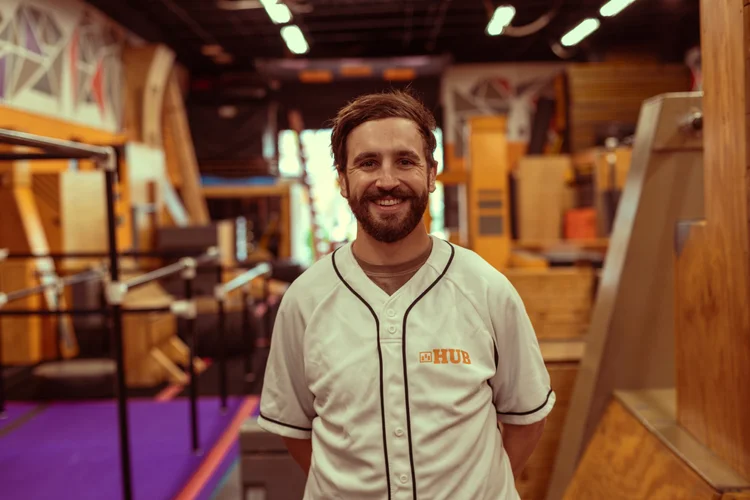
Establishing the Bay State’s premier parkour facility
Over the next nine years, Hub PTC Norton became home to a growing community of athletes. One that would foster the growth of parkour casuals, students, and professionals alike. Initially, the audience was small and dedicated, and the obstacles reflected that. There was a turf space in the front and the rest of the floor was concrete with wooden obstacles.
Over years, clientele increased, simultaneously funding the improvement of the gym. Eventually crash pads were purchased, rubber puzzle mats covered the concrete, and more permanent structures were introduced, including bars, wooden walls, and a trampoline.
Hub PTC became a second home for many. A lot of students attended classes multiple days a week, growing from teenagers into young adults under the guidance of Polin and the coaching staff. “It’s like their second home or this idea of their third place,” he said, describing a resource where students could connect with friends and build confidence while practicing their favorite hobby.
Students and former coaches Brandon Hooper and Will Hess, along with community member Giovanni Lessard, took their training more seriously. They all competed internationally in Vancouver’s Sport Parkour League (SPL), with Hooper placing first in the skill competition and Hess placing second in the speed competition during SPL3 in 2024. Hooper defended his title at SPL4, where he also placed third in speed.
As time went on, the Hub community continued to grow and so did its collective craving for architectural innovation. The owners expanded obstacles in the gym and the space became cluttered in turn. With multiple lessons running at once, coaches started to struggle as crowding created safety hazards. Coach Dalton Hurley said it was common for students to “have a mental block because they would see a hard metal bar next to a hard wooden wall, and it’s like, Dude, I’m going to hit that.” It became clear that the Massachusetts parkour community had outgrown Norton.
That revelation came to Polin just two years into the gym’s operation. That is why five years ago, in anticipation of the gym’s lease expiration, he started to look for a new property to either take its place or serve as a second location. The goal was to avoid a limbo period for students and coaches, which seemed feasible as Hub’s profitability increased. Two years into running the gym, Hub did a commercial with the healthcare organization Blue Cross Blue Shield, boosting its yearly revenue from $100,000 to $300,000. The gym even thrived during COVID, pushing revenue to about half-a-million dollars.
Pursuing a much-needed expansion
A few years ago, Polin got word of an ex-gym space in Sudbury through the platform Loopnet, an online marketplace for commercial real estate. It was not the replacement he desired, being roughly 50 minutes from Norton, but it checked off every other item on his wishlist. It was accessible, the space was significantly larger, and it already had built-in locker rooms.
Polin leaped at the opportunity, deciding to move forward with the transformation of the property. He said that if he couldn’t find a replacement for Norton before the lease was up, this new space could at least be a temporary placeholder.
The building process did not go to plan. Polin said, “We had really really crappy architects that siphoned months of time through sheer incompetence of just not knowing what to do.” That, combined with legal red tape involving fire and life-safety architects and engineers, led to a delay spanning over a year and a half. The gap left many students in limbo, while some are unable to commute to the new gym.
“It’s just so far from a lot of them, and the parents that are driving them aren’t really willing to make that drive two, three times a week like they would have at Norton,” Hooper said.
Polin added, “The closure was very emotional. … A lot of the kids who grew up in the gym have been going there multiple days a week their entire teenage and adult life.”

Resettling in Sudbury—and Norfolk
Hub PTC Sudbury is different from the Norton spot. A large part of it was built to cater to freerunning, a subset of parkour focused on creativity rather than efficiency. Professional athlete James West said, “It has all of the elements, such as springfloor, vault boxes, parkour structures, bars, resi, trampoline. … I think it’s nice to have all those different things for fun … and just to become a better athlete.”
David Ehrlich, a Boston parkour community leader and co-host of Join or Die, the biggest parkour gathering in the country, said, “I think that it’s the best gym I’ve been to in the United States. It is absolutely incredible. And I think the talent that is going to come out of this gym over the next few years is going to make a statement in the whole parkour community.”

The first classes at Sudbury took place in September. Hurley said, “So far, the energy has been through the roof … every kid who comes here is in love with it, and they’re like, This is the gym I want to go to.”
Polin didn’t give up on the Norton crowd with the new space though. Earlier this year, he found a suitable warehouse in Norfolk; roughly the same size as the Sudbury location and a 15-minute drive from Norton, the gym boasts 7,500 square feet. The only downside is higher rent, but Polin said the facility will be another big attraction for the parkour community. Many of its obstacles will be for purists who enjoy technical challenges revolving around jumps, vaults, and swings. Construction is already underway, and the hired build team is working hard to help open the doors to the public as soon as possible.