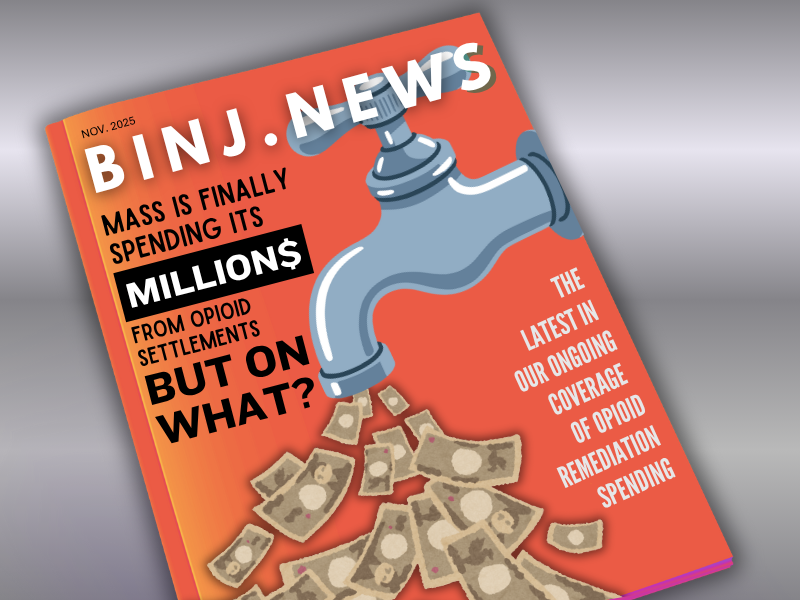
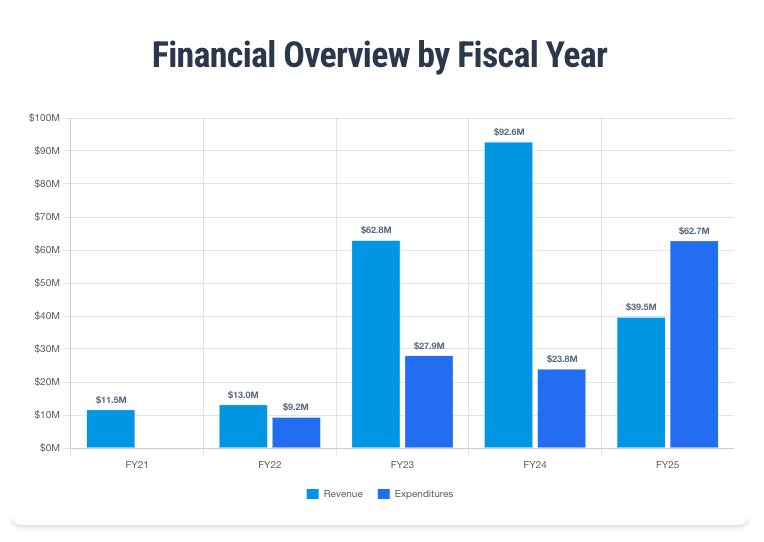
Now in its fifth year of operation, the Massachusetts Opioid Recovery and Remediation Fund (ORRF) Advisory Council spent more than $60 million in Fiscal Year 2025, spanning July 2024 to this June. That’s more than all of its expenditures over the first four years of the program combined, according to a copy of its latest annual report obtained for this article.
Per statute, the state’s Executive Office of Health and Human Services (EOHHS) is required to submit documentation detailing procurements and amounts with the clerk of either the state Senate or House of Representatives no later than Oct. 1. As of Oct. 24, the report had not been delivered. A spokesperson for the Office of the Clerk of the House said it is common for agency reports to be filed late, and gauging by our communications with ORRF, it seems that some details have yet to be reconciled. (The FY23 report, as a comparison, was delivered to lawmakers on Oct. 12, then backdated to Oct. 1, 2023.)
BINJ received a copy of the latest report on Oct. 20 from the EOHHS in response to a public records request. A review of the document indicates a failure to account for about $13 million in spending; asked about the discrepancy, a spokesperson for EOHHS said the report was still being finalized.
The flack also confirmed that the document provided to BINJ did not include approximately $8 million used to repay student loans for healthcare professionals working in the field of substance use disorder, or an additional $5 million in costs related to administrative overhead.
How state vs. local governments divide opioid settlement money
These new numbers bring ORRF’s total spending to $123.74 million since its formation in 2021. The fund has collected a total of $219.7 million over the same time period. It’s all the fruit of agreements reached between the Mass Attorney General’s Office—alongside other state, local, and tribal governments—and manufacturers and distributors of prescription pain pills such as OxyContin.
Companies including Purdue Pharma, Johnson & Johnson, and CVS agreed to pay more than $55 billion nationwide as compensation for their role in the opioid crisis, which has by some measures taken more than a million lives in the United States since 2000. Massachusetts is expected to receive a total of nearly $1 billion by 2038.
The terms of how this money will be allocated and used are explained in a document called the State-Subdivision Agreement. Under this directive, EOHHS administers a state-level fund that covers 60% of the settlements. The remaining 40% goes to municipalities and some regional partnerships.
Our prior reporting showed that more than 90% of those local dollars went unspent in the first two years; of the funds that were expended, a significant amount was directed toward administrative costs, while in some places, money meant to address opioid fallout has gone to law enforcement.
Breakdown of the state’s major FY25 opioid settlement spending
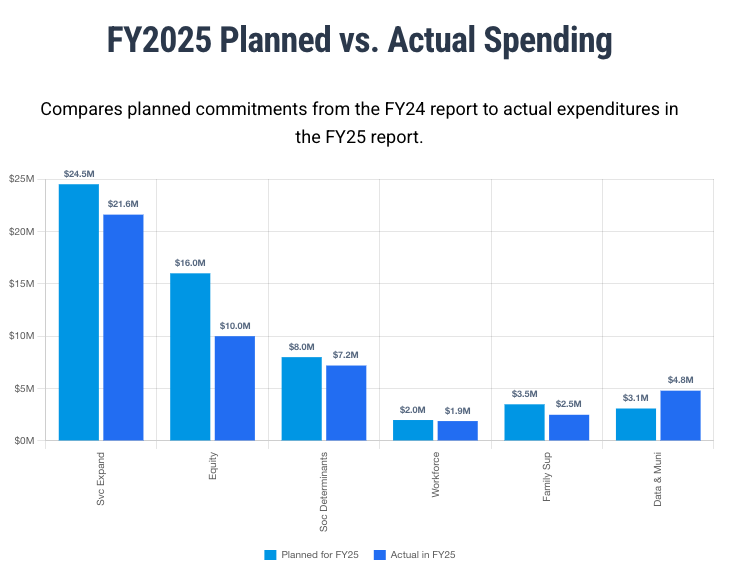
The new ORRF report provided to BINJ details $62.7 million total in FY25 spending across multiple categories, with major buckets including:
Service expansion: The council spent $21.6 million funding programs designed to help people get care for drug use. That includes access to medications for opioid use disorder, such as buprenorphine and methadone, as well as access to life-saving supplies including fentanyl test strips and naloxone plus “non-injection harm-reduction services.” This support went to hospitals, providers of outpatient addiction treatment, and Syringe Services Programs. The report did not further break down how funds in this category were allocated.
Community wellness: The new report does not clearly itemize grant spending, but announcements from the governor’s office paint the picture of the size and potential impact of certain initiatives. As one example, in an April 2024 press release, Gov. Maura Healey’s press office listed Redefining Community Wellness grants totalling $2.9 million to 20 organizations, in which each received $145,000 in monthly installments between February 2024 and June 2025.
If evenly split between fiscal years, approximately $2 million went into the community wellness grant program in FY25. The prior year’s report notes the wellness initiative too, but without a specific dollar amount. These tranches were administered by the Boston-based nonprofit Health Resources in Action. In May, the organization joined a class action suit against the US Department of Justice after the federal government announced cuts to a number of public safety and prison reform programs.
Equity: In 2024, ORRF advisors announced plans to spend $16 million on projects the body classified as related to equity. At the end of the FY25, the actual reported spending in this category was lower, just $10 million. It includes grants to nonprofits and municipalities for programs that provide various services needed by people dealing with negative impacts of drug use: recovery coaches, outreach teams that distribute harm reduction supplies, etc. While there is no money explicitly designated for the Department of Correction, the council also funded reentry programs for exiting prisoners with substance use disorder.
The Mosaic partnership
Despite the failure of Mass to hit stated spending targets around equity, there was some notable momentum in this area. In August 2024, the governor awarded $3.75 million to 18 grassroots organizations to “reduce the harms caused by the opioid epidemic in communities disproportionately impacted by overdose deaths.”
According to the state, the grants were “the first to be awarded through the Mosaic Opioid Recovery Partnership (Mosaic),” a “collaboration between the Department of Public Health’s (DPH) Bureau of Substance Addiction Services and Rize Massachusetts to increase the equitable allocation of ORRF grants to small community-based organizations and municipalities that often face significant obstacles and barriers to accessing more traditional funding opportunities.”
Recipients included Northampton based organization Harm Reduction Hedgehogs, and New Bedford-based Fishing Partnership Support Services. In another round, specifically focused on diversity, in June 2025 the state gave 30 municipalities and adjacent services providers—among them, the City of Lawrence and the Berkshire Regional Planning Commission—amounts ranging from $5,000 to $150,000 (totaling $1.5 million).
In its part, Rize, a Boston-based nonprofit contracting with Mass, recently took over the role formerly managed by the state’s Bureau of Substance and Addiction Services with global consulting firm John Snow, Inc. to train cities and towns on how to spend opioid settlement funds. The John Snow-BSAS Care Mass portal and brand have since been scrapped and refocused under the Mosaic banner, but the reason for the change in vendor is unclear.
Earlier this year, BINJ submitted a public records inquiry for files related to the Care Mass partnership. Rather than fulfill the request, the DPH petitioned the Secretary of the Commonwealth’s Public Records Division for a deadline extension to produce the records, and then deleted them.
Supervisor of Records Manza Arthur closed an appeal BINJ filed in response to the department’s “no records” response, noting that alleged “willful, malicious or wanton destruction or injury to the personal property, dwelling house or building of another … does not fall within the authority of this office.” In other words, the DPH doesn’t have to produce the documents because it destroyed them.
Additional expenditures
According to the spending report analyzed for this article, the following line items and categories account for the remainder of the $62.7 million spent by the state from opioid settlement funds in FY25:
Jobs and housing: $7.2 million to providers of recovery housing and a recovery program that emphasizes job skills.
Workforce development: $1.9 million to repay loans for 85 healthcare professionals working in substance abuse treatment programs in Massachusetts through the Substance Use Treatment Provider Loan Repayment Initiative. (A spokesperson for the Executive Office of Health and Human Services told BINJ that the council spent an additional $8 million on loan repayments that was not referenced in the report.)
Family support: $2.5 million for grief counseling for people who have lost loved ones due to substance use disorder. Also, nearly two-dozen youth organizations received funds to “identify and engage young people at increased risk for developing SUD and their families.”
Data analysis: $3 million for data collection and analysis to help the DPH track the number of opioid-related deaths, as well as the number of people receiving medical care for substance abuse. The data is available on this dashboard.
Municipal support: $1.8 million on training and technical assistance for municipalities through Mosaic.
Administrative: $1.3 million on costs related to administering these funds. A spokesperson for EOHHS told BINJ (after we received the report they provided) that an additional $5 million was spent on such administrative costs in FY25.
This article is syndicated by the MassWire news service of the Boston Institute for Nonprofit Journalism. If you want to see more reporting like this, make a contribution at givetobinj.org.
Our ongoing reporting on opioid settlement funds is supported by a grant from the Data-Driven Reporting Project (DDRP) at Northwestern University’s Medill School of Journalism.