The fear of being abducted based on race makes undocumented and documented immigrants in Somerville second-guess seeking medical attention, going grocery shopping, and accessing critical services, according to several frontline social service workers.
During the latest administrative push for large-scale, federally funded arrests of immigrants, US Immigration and Customs Enforcement focused on East Somerville, causing many to go into hiding.
One driving factor behind this is that the Supreme Court permitted ICE to use racial profiling to target people they suspect of not being citizens—which spurred widespread apprehension across immigrant communities over the safety of public gatherings.
Concerns prompted the cancellation and postponement of the Fiesta Del Rio event in Everett and Brazil Fest in Martha’s Vineyard.
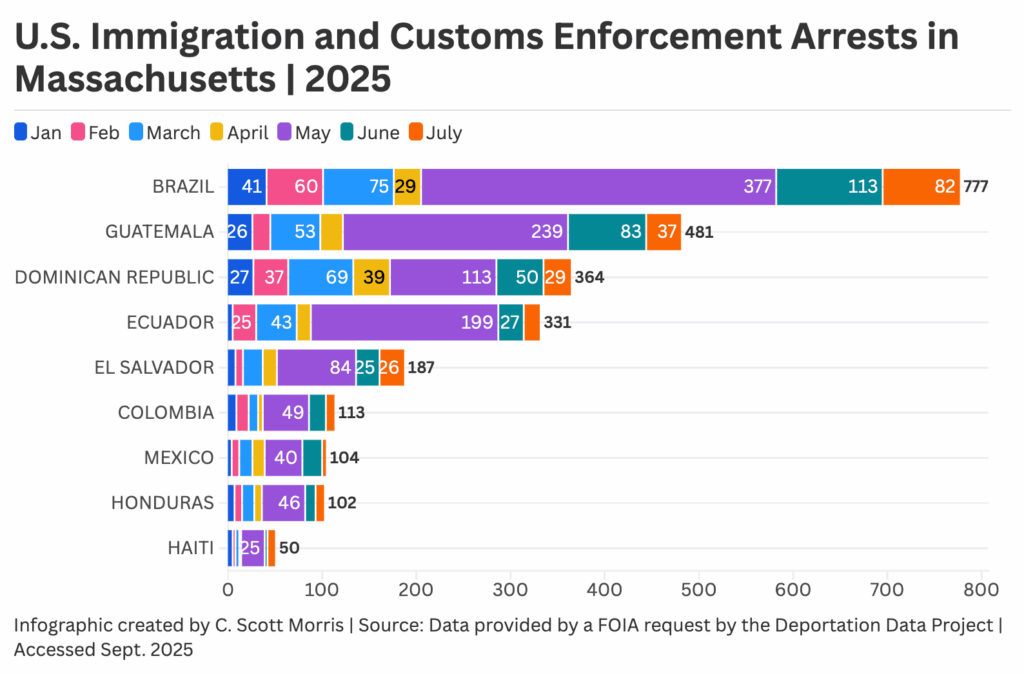
Since the beginning of 2025, the majority of ICE arrests in Massachusetts from January through late July included Brazilians, according to information uncovered by a FOIA request by the Deportation Data Project.
Jordana, a Brazilian Somerville resident speaking anonymously, said ICE activity disrupted the immigrant community’s access to social services in Foss Park. The park served as a meeting place where they could connect with contractors and find work.
Social service workers, employed by both nonprofits and the City of Somerville, used the park to check in on immigrants, knowing they would gather there, she said. She did not respond to a request for comment on whether the organizations were government funded or nonprofit.
“It’s getting worse and worse,” she said. “They [immigrants] don’t trust going to places anymore, and it’s hard [for social workers] to find them.”
She added that losing a place like Foss Park creates an imbalance where immigrants can’t find work and, subsequently, can’t make money to pay their bills.
She said communication is critical for administering social services, so when the only way to communicate is by phone, and the phone bills go unpaid, social workers can lose the single line of connection they had with clients. She said that leaves already vulnerable people in an even more dangerous situation.
Other organizations have tried to help clients connect by providing free Wi-Fi, allowing people to connect to different services without having to keep up with a phone bill. She said this has grown in popularity in the community and has helped address the communication barrier. She did not comment on which organizations offer this service.
“They are isolating themselves, not because they want to, but they’ve been forced to,” she said. “The community’s been destroyed. You see this on a daily basis.”

A sign depicts Somerville’s rich immigrant history by the Somerville Veterans Memorial Rink in Somerville, MA, Oct. 5, 2025. Photo by Christopher Morris. Copyright 2025 Christopher Morris.
Classroom Worries
Sara Kirubi, executive director at a Somerville-based nonprofit called the Welcome Project, manages programs that serve people mostly from Central and South American countries, teaching English, advocacy, and interpretation.
She said that their hardest hit programs have been for adults: their English for Speakers of Other Languages program and their English for Parents program.
“We saw our first drop in attendance right after inauguration. I think people were worried, didn’t know what was going to happen,” Kirubi said. “That was when people felt like they were in danger, and not just people who are undocumented.”
Earlier in the spring, the Welcome Project tried enrolling an in-person class, securing only five students who later stopped attending, citing immigration concerns. The class section had to be cancelled, which, she said, they had not seen since COVID.
In total, the Welcome Project has a record of 12 students who shared that they don’t plan to reenroll or attend class because they are worried about immigration actions. That is only counting the people who mentioned something, she said, noting that others simply stopped coming.
“When we see that there are abductions on our streets, we see fewer students in classes,” she said, “and then we will rebound when things have quieted down.”
She added that it’s not just in-person classes that decline in attendance at the Welcome Project but virtual classes too.
“This [abduction fear] is just causing so much panic and stress,” she said. “They don’t feel like they can pay attention to class or be committed to coming to class twice a week, even virtually, because they’re spending all of their waking hours trying to figure out what’s happening to them and how they can survive here.”
Heloisa Galvão, executive director for the Brazilian Women’s Group in Allston, said her organization has maintained some in-person meetings while also increasing their number of virtual meetings.
BWG started in Somerville in 1995 before later moving to Boston after 2001, but they continue to serve many families that live in Somerville as well as the greater Boston area.
From family and immigrant services to legal advice, BWG supports Brazilians, going so far as paying for therapy and coordinating mental health support groups.
They have held virtual meetings where spouses of those abducted can share their pain in a supportive group. She said that in the past 10 days, BWG paid nearly $7,000 to help three families pay for rent and utilities. They also purchased tickets for a family of four to fly to Brazil since the husband was detained, and they anticipate that he will be deported.
The way that ICE has conducted these operations impacts the daily life of many in the Brazilian community, Galvão said. They are no longer going to church, stores, school, doctor’s appointments or even grocery shopping, she said.
To get food, Galvão said, many Brazilians are now opting for more expensive home delivery options.
Sean O’Brien, food access coordinator for the City of Somerville and manager of the Somerville Mobile Farmer’s Market, said his office has looked at ways to get food to people in their homes to better serve seniors, people with medical issues and people who might not be able to leave their houses. However, he said the process is logistically expensive and difficult to coordinate. They have yet to find an efficient, sustainable process.

A sign posted that asks people to report any sightings of ICE officers to the LUCE hotline on Oct. 5, 2025. Photo by Christopher Morris. Copyright 2025 Christopher Morris.
Scaling Operations
The Brazilian Women’s Group had to significantly scale up their immigration communications when their previous operation got so overwhelmed, they couldn’t keep up with inquiries, she said. Initially they had one phone for three WhatsApp groups: immigration, healthcare, and general inquiries. Now they have a separate phone for each group.
Galvão didn’t comment on attendance changes among BWG’s other programs.
“We have so many people asking for help. Today I woke up to someone calling me on my private number,” she said, adding that she doesn’t see as many Brazilians reaching out to government-based social services.
“They are reaching out to community organizations,” she said, like the New England Community Center in Stoughton, and the Brazilian-American Center in Framingham.

A Massachusetts ICE Watch sticker in Portuguese, posted by Somerville Avenue on Oct. 5, 2025. Photo by Christopher Morris. Copyright 2025 Christopher Morris.
Community Engagement
Meredith Gamble, deputy director and language justice coordinator of the Somerville Office of Immigrant Affairs, focuses on referrals and connecting immigrants with the correct resources, including nonprofits and municipal organizations.
Compared to a year ago, she said that SOIA has seen more interactions taking place over the phone or virtually, but she did not disclose any numbers. She said that more people are also asking about interpretation and legal services.
“It’s probably no surprise to hear that there is a lot of fear. There’s a lot of concern about what’s happening, and at the same time, we are still connecting with folks,” she said.
“People are really having to make some very tough choices right now. These are very intimate, personal decisions about what they’re comfortable doing in terms of reaching out to their local government or other agencies for support.”
She added that SOIA continues to go out into the community in person to make connections more accessible.
“We will go to you. We are out at events. We are hosting in-person programming,” she said, adding that they do not plan on cancelling the upcoming Latin American and Caribbean Heritage Celebration on Oct. 18.
“We are aware that some of these types of celebrations are being cancelled in other communities,” she said, but she added that it will be a testament to the diversity and strength of Somerville’s community.
Commenting on the extent of the City of Somerville’s impact, Jordana noted that she doesn’t see the effective results or growth Meredith mentioned out in the community. She said solutions need to come through addressing the growing barriers between immigrant communities and social services.
“There is no space for silence. This is not an option,” Galvão said. “Don’t think that hiding will protect you. What will protect you is to be informed, is to know your rights and exercise your rights, because civil rights have not been overridden.”
“And we have rights,” she added, “we have human rights. We have civil rights. It doesn’t matter if you don’t have any documents.”
This article was produced for HorizonMass, the independent, student-driven, news outlet of the Boston Institute for Nonprofit Journalism and is syndicated by BINJ’s MassWire news service.