“Once I realized the genealogy behind it, it felt more personal and … put more fire in my belly.”
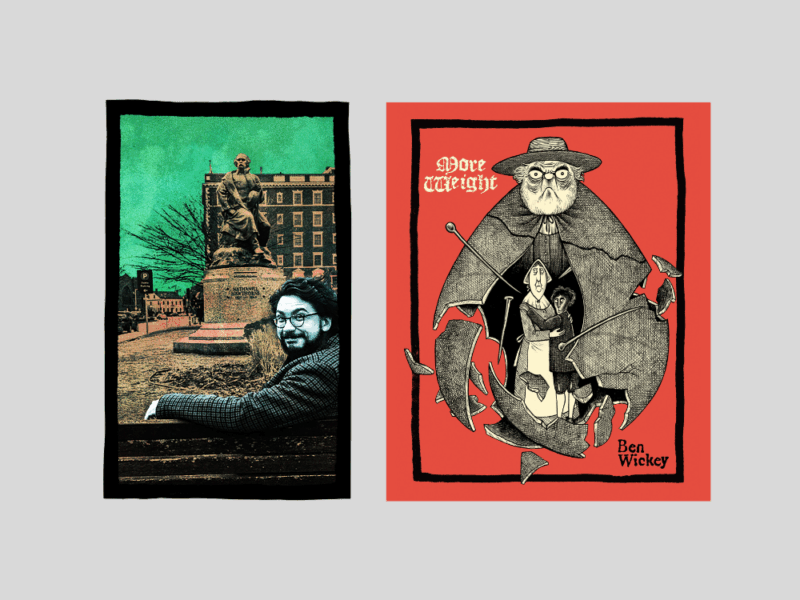
Writer and illustrator Ben Wickey was more than midway through writing and researching his book about the dark history of the Salem Witch Trials, titled “More Weight: A Salem Story,” when he made an incredible discovery. Mary Easty, one of the more famous women to be executed for “being a witch” in Salem during the late 1600s, was one of his great-grandmothers.
Easty was one of many people burned or drowned after being accused of witchcraft in Massachusetts, but she stands out in American history because of her eloquence, ability to write, and her selflessness. By 1692, both of her sisters, Rebecca Nurse, 71, and Sarah Cloyce, 53, were in jail, and their mother, Joanna Towne, had been accused of witchcraft herself years before.


The “very human” story behind the Salem Witch Trials
On Oct. 4, Wickey is set to return, signing copies of “More Weight” at the House of Seven Gables on Derby Street. He’s spent a lot of time in the area. According to the artist’s research of old records at the Salem Witch Museum, Easty was likely accused due to an ongoing border and property dispute (generally resolved in the Towne’s favor) between the extended Towne family, living in Topsfield and Salem Village, and the Putnam family of Salem Village. Speaking for this article, Wickey said he was compelled to dig into the historical records to suss out the “very human” story behind the trials.
After receiving her death sentence on Sept. 9, 1692, Easty petitioned the governor, the court, and the ministers that “no more innocent blood may be shed.” Her plea—that afflicted accusers should be separated from each other before they’re questioned, and that confessing “witches” should also be tried—inspired writer Charles Upham, whose book “Salem Witchcraft” includes a full account of the trials.
Easty was hanged, along with Martha Corey, Alice Parker, Mary Parker, Ann Pudeator, Wilmot Redd, Margaret Scott, and Samuel Wardwell on Proctor’s Ledge at Gallows Hill on Sept. 22, 1692.
Wickey said he was at a family gathering a few years ago when one of his cousins casually mentioned that they were distantly related to the historical figure. By then, he had already started writing and researching the book, but the revelation changed things.
“I just wanted to get the truth right at the beginning,” he said. “But then once I realized the genealogy behind it, it felt more personal and I actually got a bit more angry. … It put more fire in my belly.”


Illustrating the political atrocity of the Salem Witch Trials
Wickey’s debut graphic novel, which dropped on Sept. 23, is self-illustrated, written and hand-lettered. “More Weight” opens in the 1860s, as famed writers Nathaniel Hawthorne and Henry Wadsworth Longfellow stroll the streets of Salem together, reflecting on their own “dark connections” to the era.
The Salem Witch Trials weren’t the first or last witch hunts in American history, but as the best documented, they’re often reduced to a hysteria, Wickey said. He wasn’t interested in “people with pitchforks, settlers running around with buckles on their hats, or prepubescent girls writhing around on the floor accusing people of witchcraft.”
“I was more interested in the political aspect,” he said. “This idea of this was an atrocity that was legally allowed to happen. And it wasn’t a mistake. Everyone was doing this by the book. These people were arraigned and tried by the most sophisticated court that New England had.”
In time, Wickey added, the government got involved, including clergymen and officials in Boston—not to protect the innocent, but more so in protection of the hegemony. Today, witch hunts still happen in some parts of the world, including Africa and India, for the same mundane reasons that they happened in the west.
“Petty jealousies, landlust, these are also happening and the story will never not be relevant,” Wickey said. “So it was my hope, starting out with this book and finishing it after 10 years, to do it right, to use the medium of comics.”
Previously, Wickey worked as one of the contributing illustrators of Alan Moore’s “The Moon and Serpent Bumper Book of Magic,” and illustrated Ki Longfellow’s “The Illustrated Vivian Stanshall.” He has also directed several stop-motion animated short films, including the award-winning “The House of the Seven Gables.”
Order “More Weight” from Top Shelf Productions